![★ August 1894, View of eight 10th Cavalry Regiment (Buffalo Soldiers) posed in a wooded area while escorting General Merritt’s party, St. Mary, Montana. Montana Historical Society Library and Archives [957-993].](https://images.squarespace-cdn.com/content/v1/6535b7e96b6e1403bcc579a8/04997e17-31f5-482e-aadc-e3914f6e1493/Screenshot+2025-07-11+at+10.35.48+AM.png)
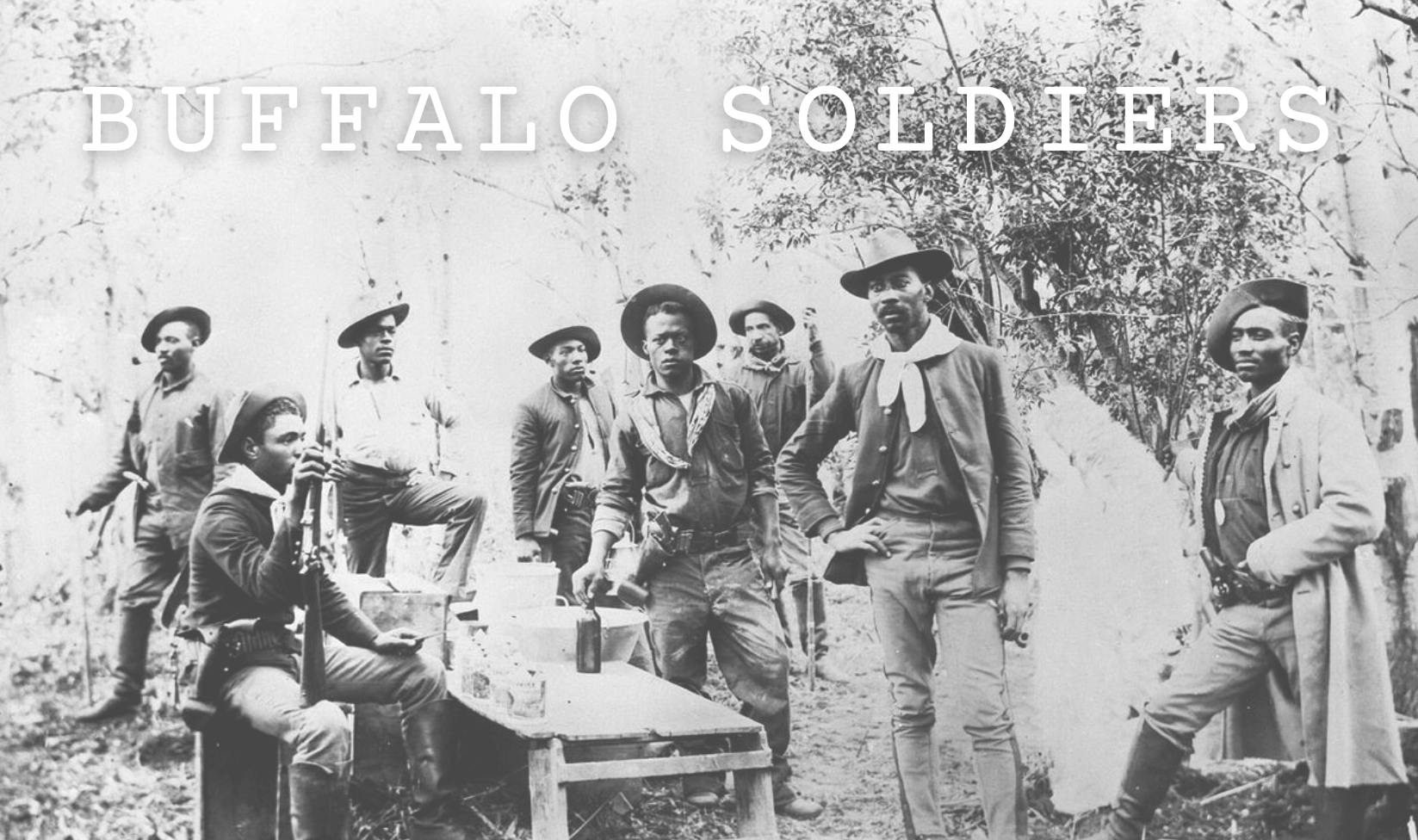
★ August 1894, View of eight 10th Cavalry Regiment (Buffalo Soldiers) posed in a wooded area while escorting General Merritt’s party, St. Mary, Montana. Montana Historical Society Library and Archives [957-993].
![A Denver Public Library image, with a cropped background, showing a Black Corporal Buffalo Soldier, 9th cavalry at Lakota Sioux Pine Ridge Agency, South Dakota [x-31308]](https://images.squarespace-cdn.com/content/v1/6535b7e96b6e1403bcc579a8/6b76d253-5188-42a7-a59d-3969e6a407cc/A+Black+Corporal+Buffalo+Soldier%2C+9th+cavalry+at+Lakota+Sioux+Pine+Ridge+Agency%2C+South+Dakota.png)
★ BUFFALO SOLDIERS ★
In 1866, the U.S. government passed a law creating six segregated military regiments to aid in America’s expansion into the West and other territories. The duties of these all-Black regiments included escorting survey parties, wagon trains, and U.S. postal workers throughout the Western frontier; testing new military technologies; and stationing a military presence in lands seeing an influx of emigrants while actively being inhabited by the indigenous populations that had long since called it home.
★ PICTURED HERE ★
c. March 1891, (Background Removed) Corporal in the 9th Cavalry Buffalo Soldier poses on his horse on the Lakota Sioux Pine Ridge Agency, South Dakota. He wears a military uniform and has a gun in a holster on his belt. Snow covers the ground in the background of the original image. Denver Public Library Special Collections [X-31308].
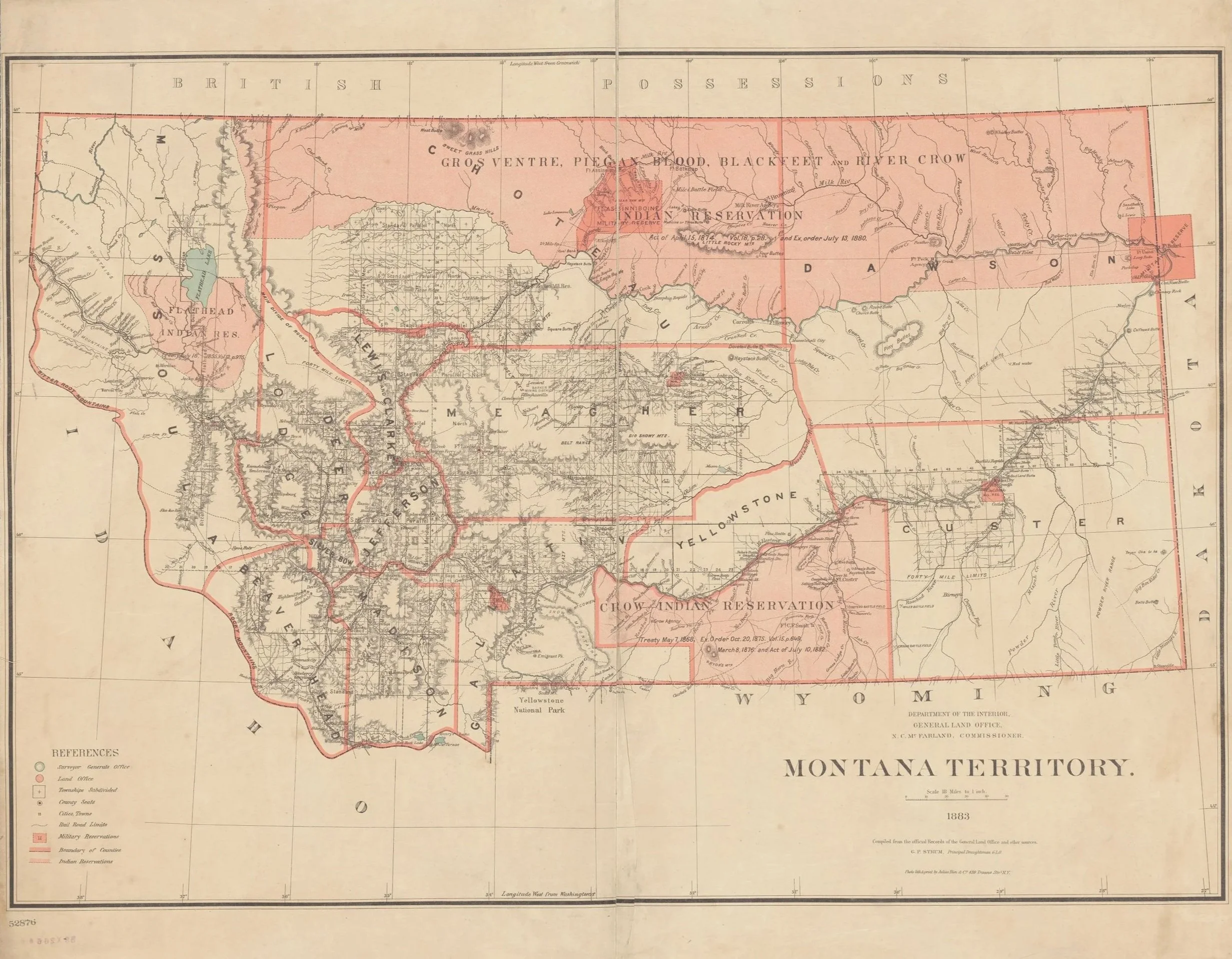
MAP BACKGROUND: c. 1869, Lionel Pincus and Princess Firyal Map Division, The New York Public Library. "Railway & tourists map of the United States: showing the new lines of railway to the Pacific Ocean," New York Public Library Digital Collections. Image ID [57175963].
As Black History Scholar William Loren Katz put it in his documentary and pictorial history book, The Black West, “By 1870, the goal of preserving peace with Native Americans—made impossible by Washington policy and the white appetite for Indian land—fell to 30,000 federal soldiers, including 2,700 former slaves.”
As the story goes, the regiments are famously referred to as the ‘Buffalo Soldiers’ based on the soldiers’ hair and skin color resembling that of the American bison, a vital resource to tribal nations whose way of life was following the herds across the plains.
For almost 100 years, the all-Black regiments led an instrumental era of military service in the United States and during several deployments.
![★ c. 1898, Stereograph of Ninth Cavalry Regiment, African American soldiers of Troop A, 9th U.S. Cavalry, on horseback during the Spanish American War. Library of Congress Prints and Photographs Division, Digital ID [ds 05462].](https://images.squarespace-cdn.com/content/v1/6535b7e96b6e1403bcc579a8/e6254214-cdc4-4450-a6ce-997b505ad4d5/Troop+A%2C+Ninth+U.S.+Cavalry+cropped+stereograph.jpg)
★ c. 1898, Stereograph of Ninth Cavalry Regiment, African American soldiers of Troop A, 9th U.S. Cavalry, on horseback during the Spanish American War. Library of Congress Prints and Photographs Division, Digital ID [ds 05462].
![★ c. 1890, Photograph of eight troopers of the U. S. 10th Cavalry Regiment, probably at Fort Apache, Arizona. General Photograph Collection, University of Texas at San Antonio. Image ID [075-0299].](https://images.squarespace-cdn.com/content/v1/6535b7e96b6e1403bcc579a8/58583f71-f59f-4b73-ae15-4a7b3abac585/p9020coll008_10018_full.jpg)
★ c. 1890, Photograph of eight troopers of the U. S. 10th Cavalry Regiment, probably at Fort Apache, Arizona. General Photograph Collection, University of Texas at San Antonio. Image ID [075-0299].
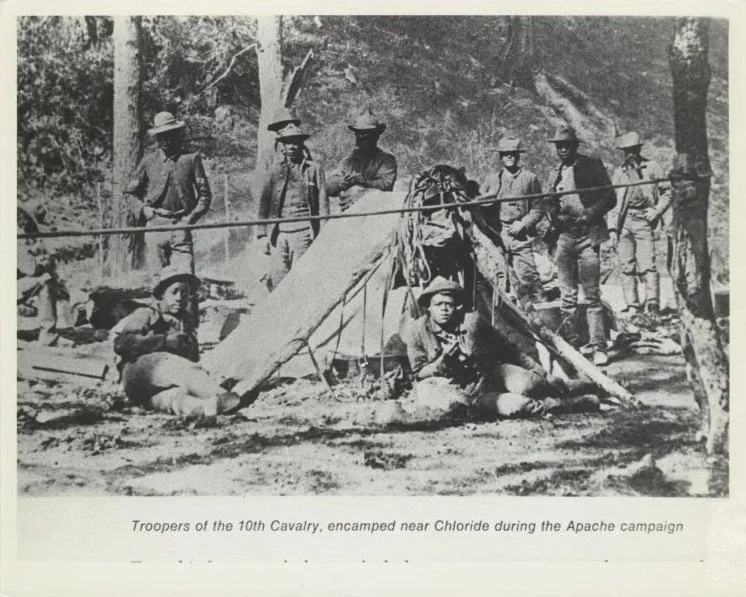
★ c. 1870 - 1890, Buffalo Soldier Troopers of the 10th Cavalry, encamped near Chloride during the Apache campaign. Schomburg Center for Research in Black Culture, Photographs and Prints Division. Military, Buffalo Soldiers/Indian Campaigns, 1870s-1880s. The New York Public Library, Digital Collections. IMAGE ID 1947347.
★ Motion graphic of the following cabinet card photograph: Sunday morning, December 14, 1890, Buffalo Soldiers of the 25th Infantry pose in the snow wearing uniforms and buffalo robes at Fort Keogh, Montana. Gladstone Collection of African American Photographs, Library of Congress Prints and Photographs Division. Call No. LOT 14024, no. 65 [P&P].
![★ c. 1898, Stereograph of Ninth U.S. Cavalry--famous Colored Regiment of African American soldiers on horseback. Library of Congress Prints and Photographs Division. Digital ID [cph 3g07967].](https://images.squarespace-cdn.com/content/v1/6535b7e96b6e1403bcc579a8/efa63d72-56a6-4019-83d9-191985c75b96/1898+-+LOC+Buffalo+Soldiers+9th+Cavalry+stereograph+CROPPED.jpg)
★ c. 1898, Stereograph of Ninth U.S. Cavalry--famous Colored Regiment of African American soldiers on horseback. Library of Congress Prints and Photographs Division. Digital ID [cph 3g07967].
![★ c. 1890s, Group of African American soldiers of the 25th Infantry from Fort Missoula posed in uniform, between the rocks in a canyon. University of Montana Mansfield Library, Morton J. Elrod Papers, Mss 486. Image ID [B.I.j-3].](https://images.squarespace-cdn.com/content/v1/6535b7e96b6e1403bcc579a8/cffc3a5c-de6c-423a-9490-77f76b1443c1/Screenshot+2025-10-12+at+5.56.24+PM.png)
★ c. 1890s, Group of African American soldiers of the 25th Infantry from Fort Missoula posed in uniform, between the rocks in a canyon. University of Montana Mansfield Library, Morton J. Elrod Papers, Mss 486. Image ID [B.I.j-3].
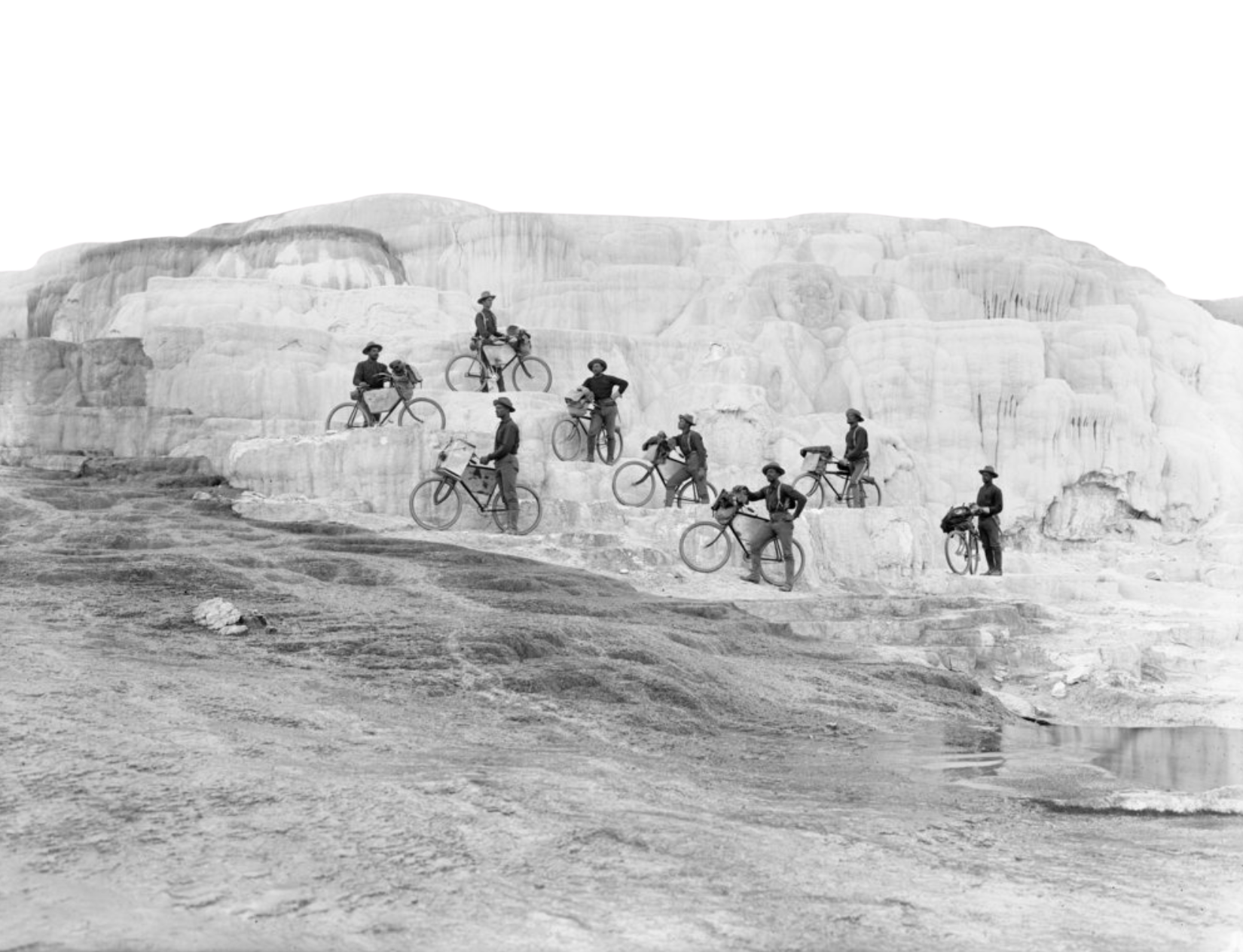
★ 25th INFANTRY BICYCLE CORPS | 1897 ★
In the 1890s, the U.S. Military formed the 25th Infantry Bicycle Corps to “run a series of lengthy excursions utilizing the world’s latest technology.” → The bicycle.
Fort Missoula, Montana, became the site for such testing via the all-Black Buffalo Soldier regiment. Their task was to trek across five states, making an impossible 1,900-mile journey possible. They rode across unpaved, rough terrain, all while carrying their military gear and supplies. These “Iron Riders,” as they were often referred, started the arduous journey on June 14, 1897, and navigated rough terrain before reaching their destination in St. Louis on July 24.
↓ The motion graphic below is a map of their route. The map and photographs in this section are preserved by the Montana Historical Society Library and Archives.
★ PICTURED HERE ★
October 7, 1896, (Background Removed) 25th Infantry Bicycle Corps with bicycles posed on the side of Minerva Terrace at Mammoth Hot Springs, Yellowstone National Park, Wyoming. Montana Historical Society Library and Archives. Haynes Foundation Photograph Collection. Image ID [H-03614]. See larger version below.
BELOW: c. 1896, Map showing the Route of the 25th Infantry Bicycle Corps, from Fort Missoula, Montana to St. Louis, Missouri. National Archives.
![1897, 25th Infantry Bicycle Corps in formation. University of Montana Mansfield Library [73.0031].](https://images.squarespace-cdn.com/content/v1/6535b7e96b6e1403bcc579a8/6b496393-fac5-439e-ac31-55fb6b3f82ce/Screen+Shot+2022-11-14+at+10.18.36+AM.png)
1897, 25th Infantry Bicycle Corps in formation. University of Montana Mansfield Library [73.0031].
![1896, 25th Infantry Bicycle Corps crossing a creek, location unknown. University of Montana Mansfield Library, Edward H, Boos Photographs, Mss 672 [672.239].](https://images.squarespace-cdn.com/content/v1/6535b7e96b6e1403bcc579a8/38df7d23-8340-4f96-847f-571aa883b686/Screen+Shot+2022-11-14+at+10.19.33+AM.png)
1896, 25th Infantry Bicycle Corps crossing a creek, location unknown. University of Montana Mansfield Library, Edward H, Boos Photographs, Mss 672 [672.239].
![1897, 25th Infantry Bicycle Corps stationed at Fort Missoula, Montana. Soldiers are shown in their camp. University of Montana Mansfield Library [73.0030].](https://images.squarespace-cdn.com/content/v1/6535b7e96b6e1403bcc579a8/e3f6a016-ddb4-4b5a-8785-1a5ceed7fb55/1897%2C+25th+Infantry+Bicycle+Corps+stationed+at+Fort+Missoula.jpg)
1897, 25th Infantry Bicycle Corps stationed at Fort Missoula, Montana. Soldiers are shown in their camp. University of Montana Mansfield Library [73.0030].
![1897, 25th Infantry Bicycle Corps walking with their bikes in formation. University of Montana Mansfield Library [672.238]](https://images.squarespace-cdn.com/content/v1/6535b7e96b6e1403bcc579a8/7a5e6f6e-c7cc-4982-b993-bf84bf008c4e/umt013955.jpg)
1897, 25th Infantry Bicycle Corps walking with their bikes in formation. University of Montana Mansfield Library [672.238]
![October, 7, 1896, 25th Infantry Bicycle Corps riding at the top of Minerva Terrace, Mammoth Hot Springs, Yellowstone National Park. Montana Historical Society Library and Archives, Haynes Foundation Photograph Collection [H-03616].](https://images.squarespace-cdn.com/content/v1/6535b7e96b6e1403bcc579a8/7f40a186-1bd0-4eb2-a23e-4d426acbedef/764319-max.jpeg)
October, 7, 1896, 25th Infantry Bicycle Corps riding at the top of Minerva Terrace, Mammoth Hot Springs, Yellowstone National Park. Montana Historical Society Library and Archives, Haynes Foundation Photograph Collection [H-03616].
![October 7, 1896, 25th Infantry Bicycle Corps pushing their bicycles up the side of Minerva Terrace at Mammoth Hot Springs in Yellowstone National Park. Montana Historical Society, Haynes Foundation Photograph Collection [H-03615].](https://images.squarespace-cdn.com/content/v1/6535b7e96b6e1403bcc579a8/422fd8b9-797b-43f3-99c9-6d98b5f387ef/694392-max.jpeg)
October 7, 1896, 25th Infantry Bicycle Corps pushing their bicycles up the side of Minerva Terrace at Mammoth Hot Springs in Yellowstone National Park. Montana Historical Society, Haynes Foundation Photograph Collection [H-03615].
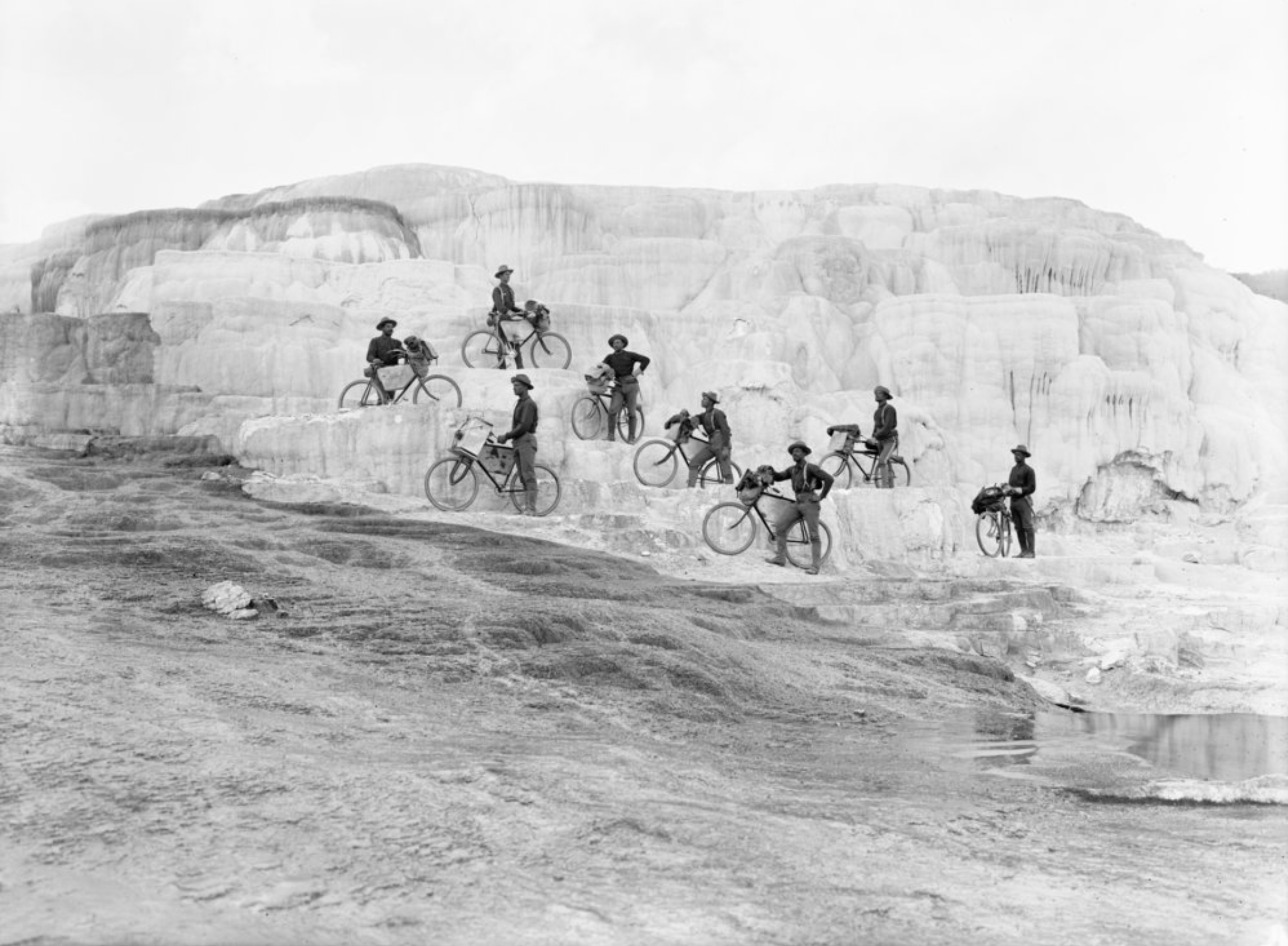
★ October 7, 1896, 25th Infantry Bicycle Corps with bicycles posed on the side of Minerva Terrace at Mammoth Hot Springs, Yellowstone National Park, Wyoming. Montana Historical Society Library and Archives. Haynes Foundation Photograph Collection. Image ID [H-03614].
★ BUFFALO SOLDIERS, READING + RESOURCE LIST ★
Jean Blackwell Hutson General Research + Reference Division
Buffalo Soldiers / by The Schomburg Center for Research in Black Culture (2004) / Call No. Sc C 11-130. / SUMMARY: Book of postcards representing photographs featured in the 2003-2004 Buffalo Soldiers exhibition hosted at the Schomburg Center for Research in Black Culture.
Buffalo Soldiers in California: Charles Young and the Ninth Cavalry, 1902 - 1904 / by Brian G. Shellum (2024) / Call No. Sc E 24-993.
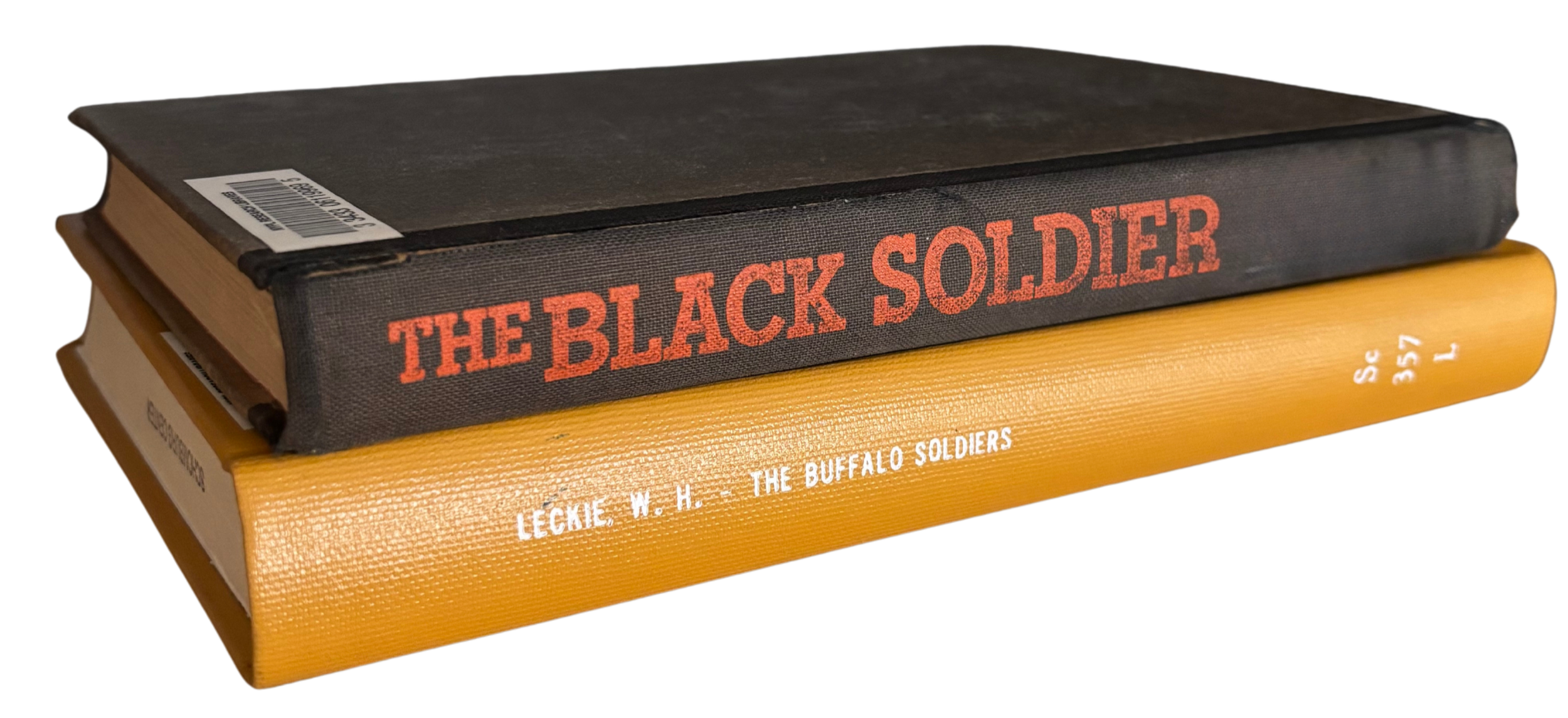
The Buffalo Soldiers: A Narrative of the Black Cavalry in the West / by William H. Leckie, with Shirley A. Leckie (2003) / Call No. Sc E 04-511.
Buffalo Soldiers in the West: A Black Soldiers Anthology / edited by Bruce A. Glasrud and Michael N. Searles (2007) / Call No. Sc E 07-1134.
The Forgotten Heroes: The Story of the Buffalo Soldiers / by Clinton Cox (1993) / Call No. Sc D 94-1017.
Black Valor: Buffalo Soldiers and the Medal of Honor, 1870 - 1898 / by Frank N. Schubert (1997) / Call No. Sc E 97-417.
The Buffalo Soldiers: Their Epic Story and Major Campaigns / by Debra J. Sheffer (2015) / Call No. Sc E 15-1067.
The Buffalo Soldiers / by TaRessa Stovall (1997) / Call No. Sc E 02-178.
The Buffalo Soldiers: We Go Deal with the System / by Abdullah Bin Juttie (2002) / Call No. Sc D 07-2614.
Buffalo Soldiers / by Catherine Reef (1993) / Call No. Sc E 93-533. / SUMMARY: “Recounts the deeds of the 9th and 10th Cavalry, comprised of African American soldiers who kept peace between Indians and settlers on the western frontier, fought in the Spanish-American War, and pursued the outlaw Pancho Villa through Mexico.”
Buffalo Soldiers / by Tom Willard (1996) / Call No. Sc D 96-578.
Buffalo Soldiers in Arizona / by John P. Langellier (2025) / Call No. Sc E 26-291.
Buffalo soldiers: The Colored Regulars in the United States Army / T.G. Steward; foreword by Frank N. Schubert (2003) / Call No. Sc D 06-1122.
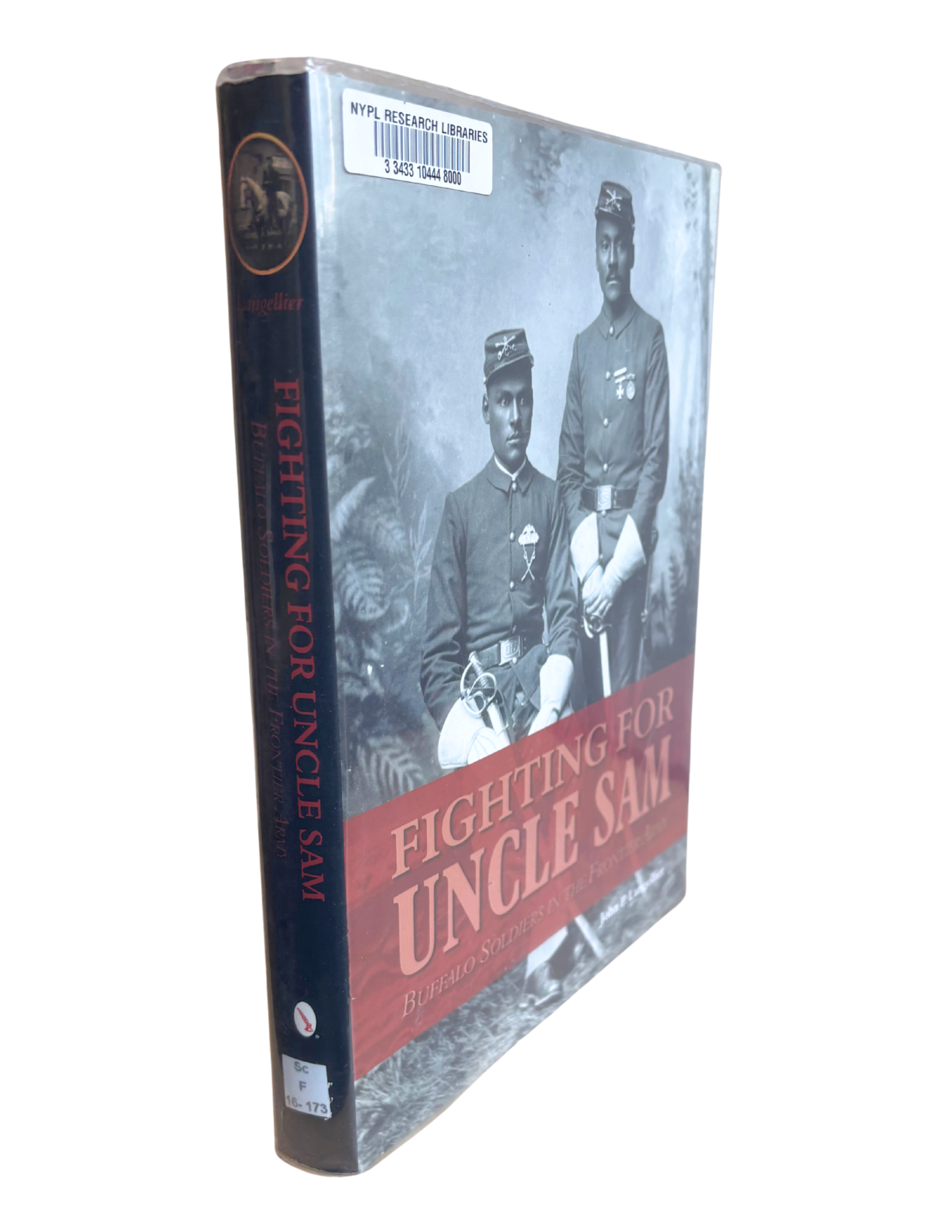
Fighting for Uncle Sam: Buffalo Soldiers in the Frontier Army / by John P. Langellier (2016) / Call No. Sc F 16-173.
Men A-Marching: The African American Soldier in the West, 1866-1896 / by John P. Langellier (1995) / Call No. Sc F 16-189.
Moving Images + Recorded Sound Division
Buffalo Soldiers Wrapped in Steel / 25min, WDIV-TV Post Newsweek Stations Michigan, Inc. (1989) / Executive Producer, Laurie Oberman; Writer/Producer, Ted Talbert. / Call No. Sc Visual VRA-887.
The Different Drummer: Blacks in the Military / 176min, WNET/Thirteen (1983) / Producer, Researcher and Director, William Miles. / Call No. Sc Visual VRA-135 a-b.
Manuscripts, Archives + Rare Books Division
Melvin McCaw Military Records 1889 - 1917 / Call No. Sc MG 270. / SUMMARY: Military records documenting Melvin McCaw's career as a non-commissioned officer in the 9th Regiment of the U.S. Cavalry from 1896 to 1917, and the activities of this segregated African American regiment at West Point after 1907.

*CLICK ANY IMAGE BELOW ⇩ to continue exploring related photographs + resources.