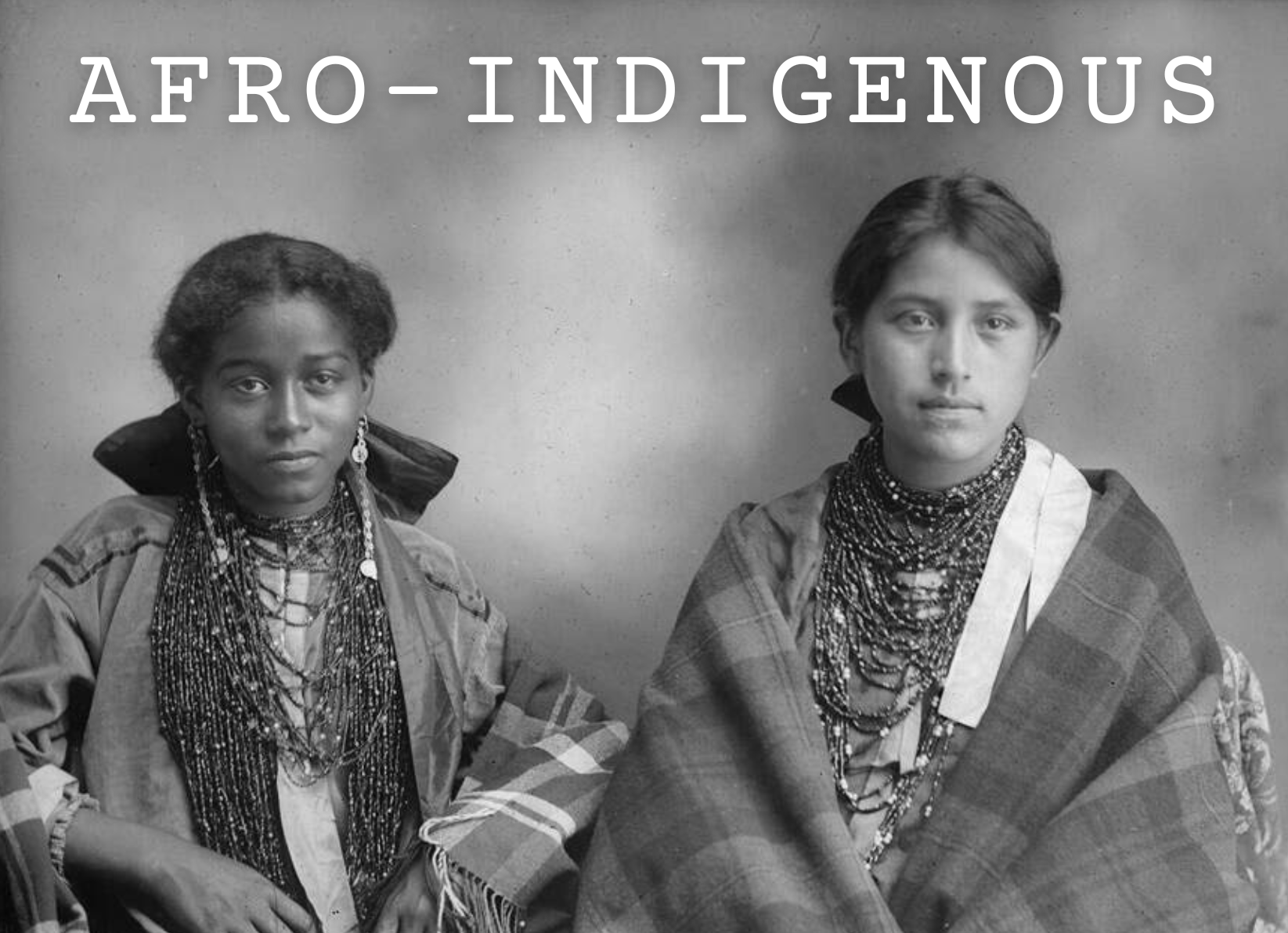
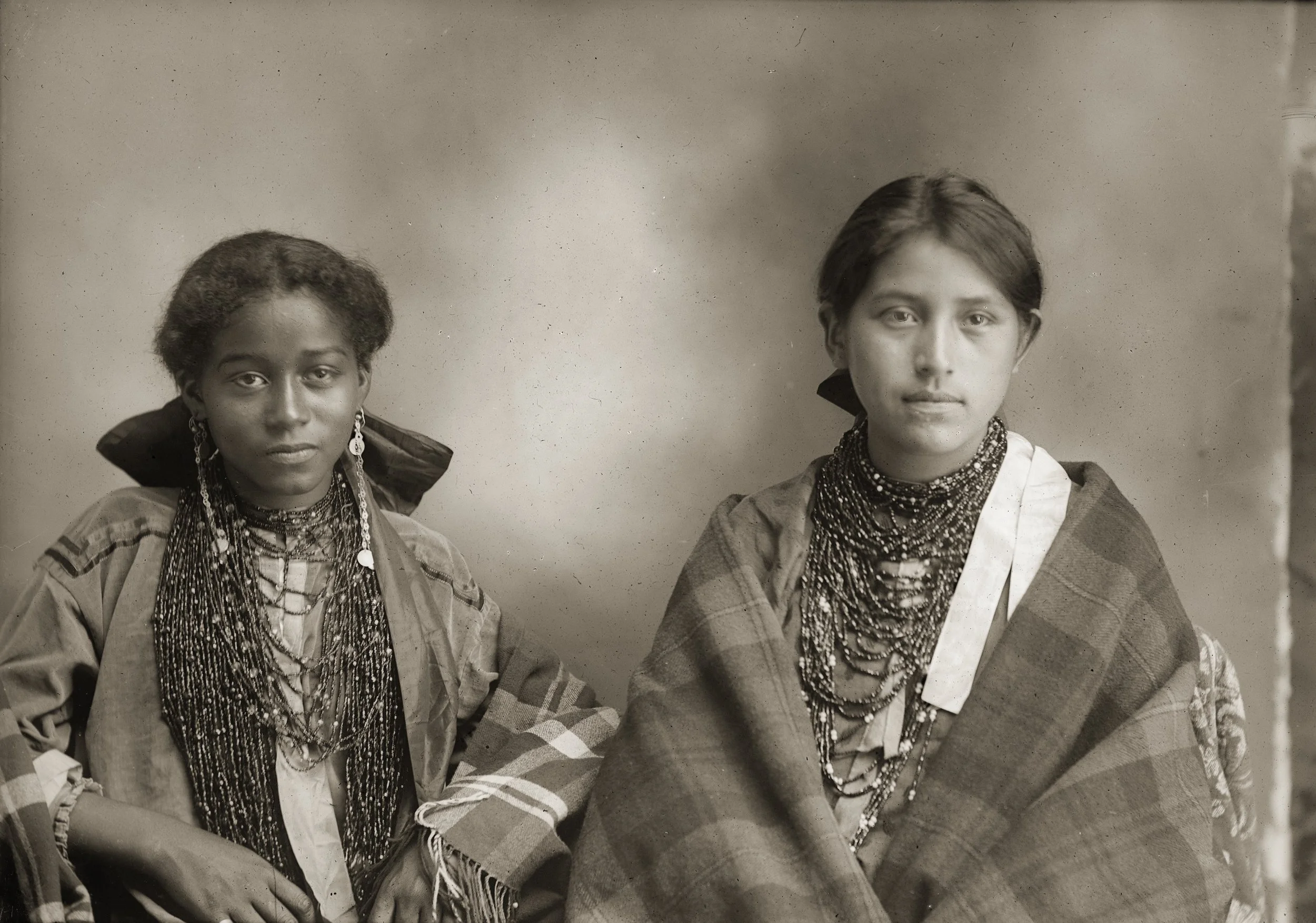
★ 1904, Portrait of two young Ho-Chunk women, seated wearing beaded necklaces and wrapped in shawls. Carrie Elk (Enookah) sits on the left, and is of mixed African American and Ho Chunk heritage. She was the daughter of Lucie Elk. Annie Lowe Lincoln (Red Bird) sits on the right, daughter of King of Thunder. Annie and Carrie were cousins. Wisconsin Historical Society, Image ID W0146PN.
★ AFRO-INDIGENOUS ★
Within the layers of America’s westward expansion during the 19th century lies the unique socio-cultural commingling of African-descended people and many nations of Indigenous populations, by way of enslavement and/or escape from slavery, military tours, pioneering, frontier trades, and so much more.
As much curiosity surrounds the topic of Afro-Indigeneity, the following digitized photographs and reading lists help contextualize these identities. Some of the historical materials presented here—to preserve and make available the historical record—reflect outdated terms and views. For more information about the library’s statement on potentially harmful content, click here.

★ c. 1876 - 1879. Black Seminole Camp, near Fort Clark, Texas. The Miriam and Ira D. Wallach Division of Art, Prints and Photographs: Photography Collection, The New York Public Library. The New York Public Library Digital Collections. IMAGE ID [G92F037_014F]
⇩⇩⇩ The following photographs are physically and digitally preserved by various institutions.
*Please refer to the captions for further details.
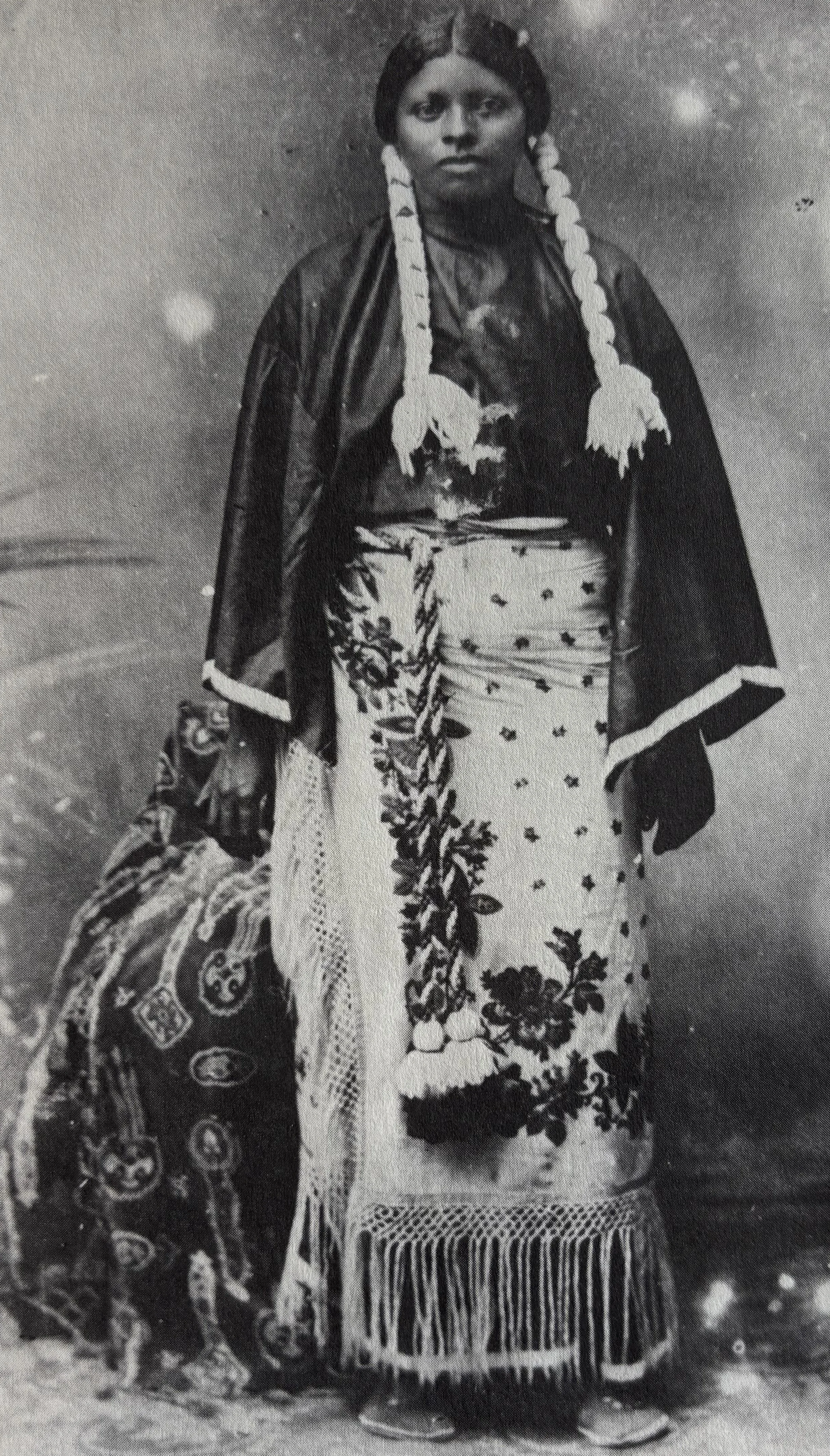
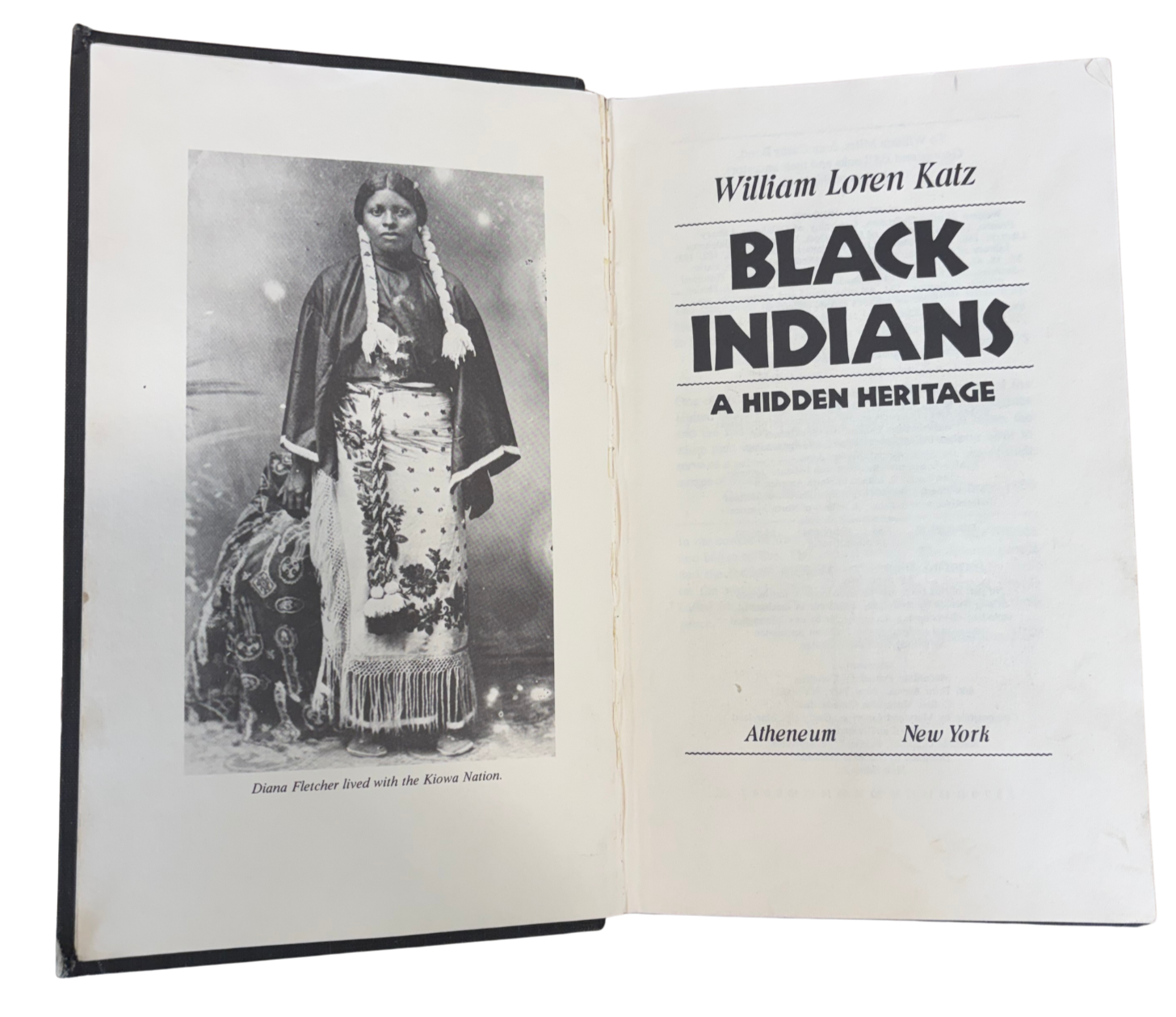
★ c. late 1800s, early 1900s, Studio portrait of a woman named Diana Fletcher. Public Domain image, Wikimedia Commons. ★ Based on several sources, including William Loren Katz, "Black West," she was believed to be of African American and Kiowa heritage, and lived among the Kiowa people. Katz, 1986.
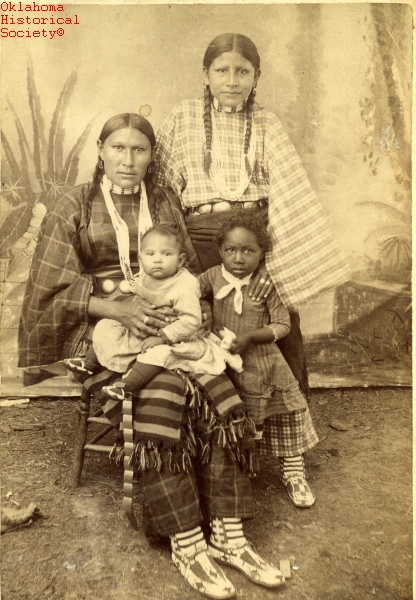
★ Portrait of Mary Bunhio Longneck (Daughter of Cheyenne Chief) and family. Longneck was the wife of Amos Chapman (U.S. Army Scout), of the Southern Cheyenne people. Courtesy of the Oklahoma Historical Society, Czarina Conlan Collection Photographs.
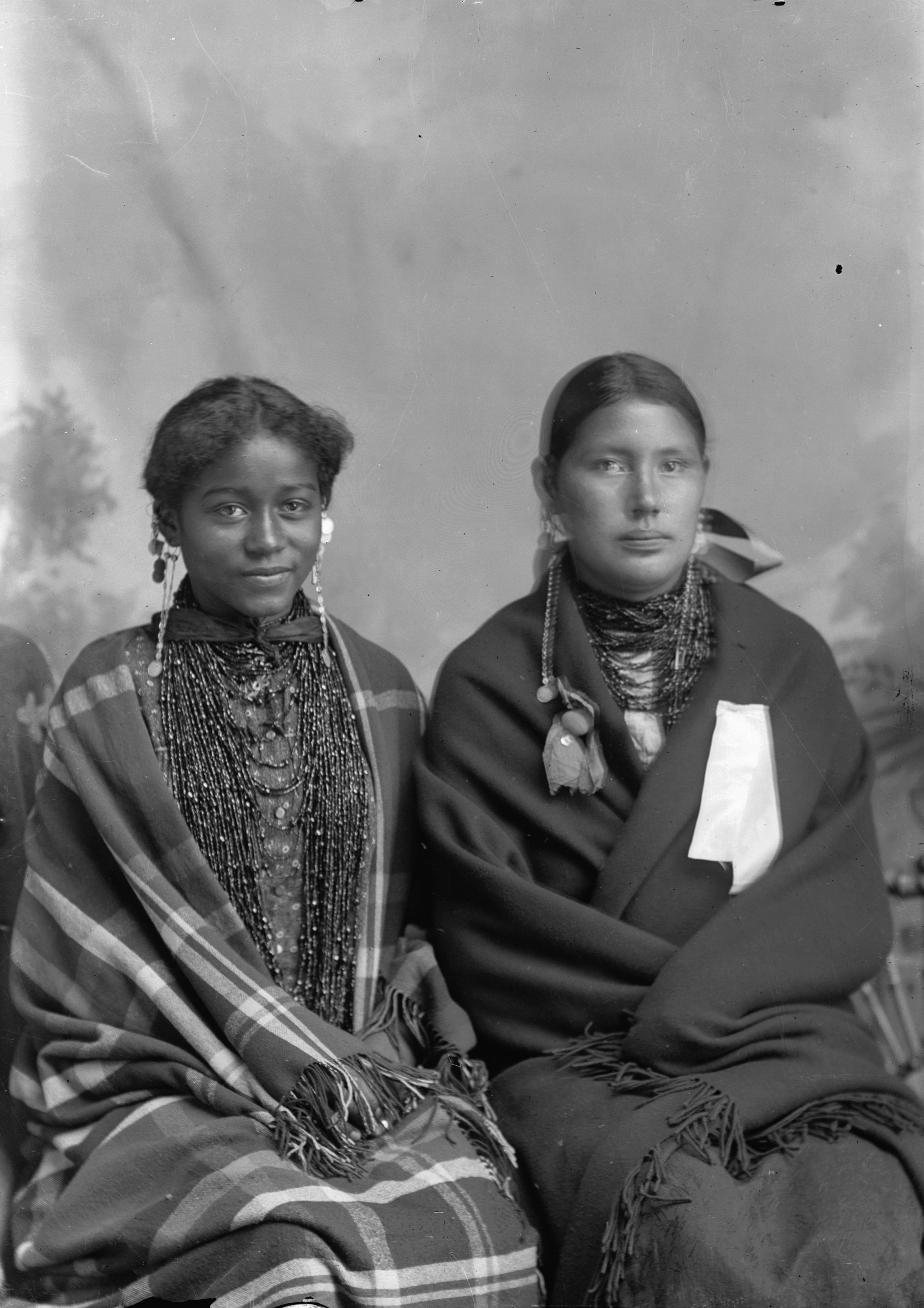
★ c. early 1900s, Portrait of two young Ho-Chunk women, seated wearing beaded necklaces and wrapped in shawls. Carrie Elk sits on the left, and is of African American and Ho Chunk heritage. Wisconsin Historical Society. Image ID W0127R1.
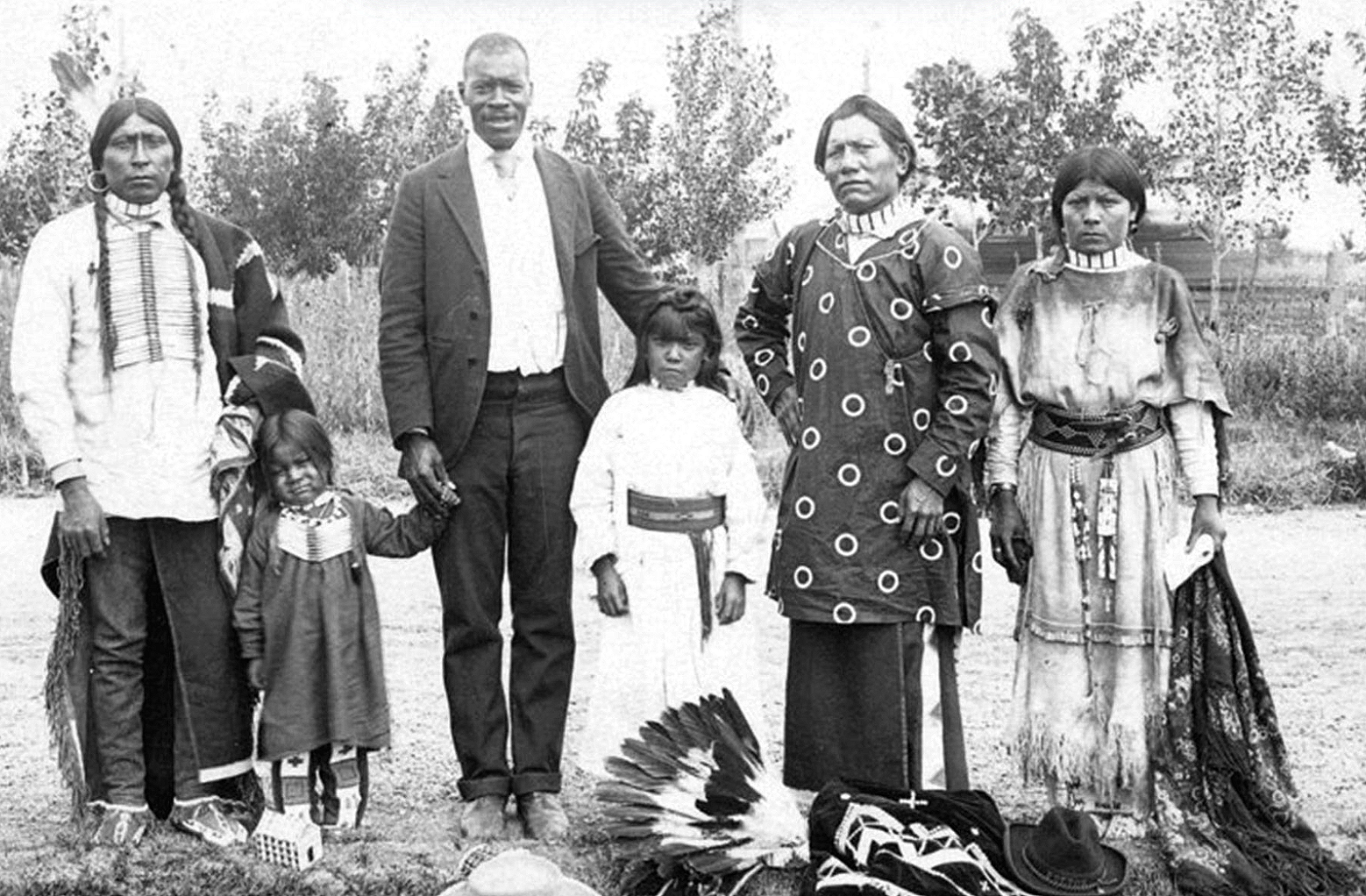
★ c. early 1900s, group portrait of Ute Tribe members with John Taylor on the Uintah Reservation. John Taylor was married to Kitty Cloud, a Ute woman, with whom he had four children. History Colorado, Record 894.367.3.
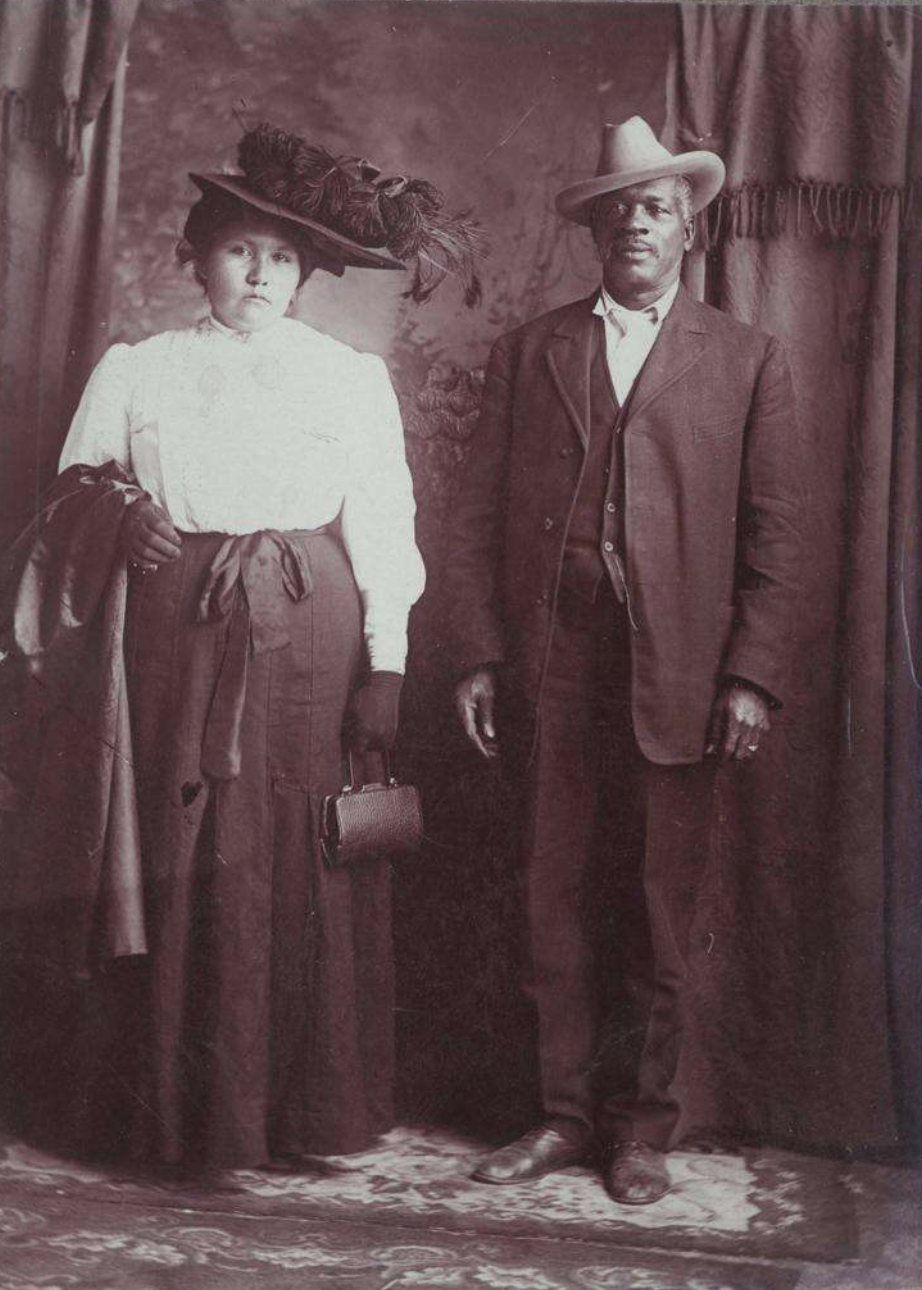
★ October 11, 1907, John Taylor and wife, Kitty Cloud (Ute), photographed on their wedding day; they had four children. Courtesy, La Plata County Historical Society.
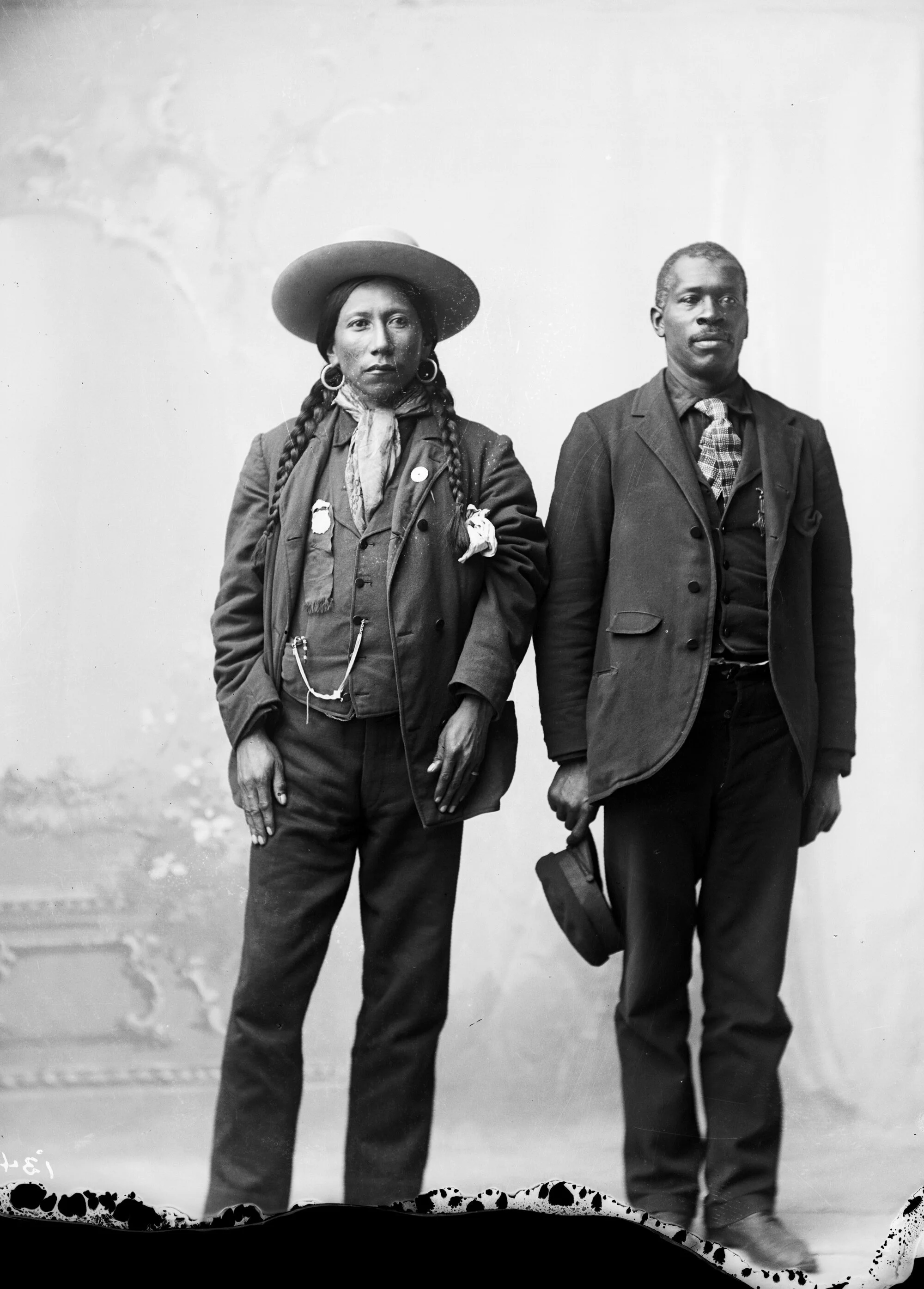
★ c. 1880 - 1910, studio portrait of Johny Taylor (right) and Dick "Buckskin" Charley, of Ute heritage (left). ★ John Taylor was a formerly enslaved Civil War Union Army Veteran, who migrated to the West and became involved with indigenous nations as a Buffalo Soldier and interpreter. He is cited as having married multiple indigenous women throughout his life. He is pictured here with his wife, Kitty Cloud (also pictured in this section), a Ute woman, on their wedding day. They had four children. Denver Public Library Special Collections, [X-30642].
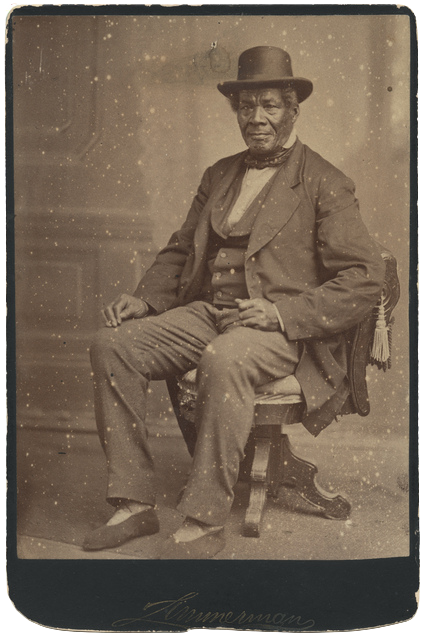
★ c. 1870, Portrait of George Bonga. Minnesota Historical Society, Locator No. [por 11261 r1] ★ George Bonga was an African American and Ojibwe (or Chippewa, Anishinaabe) Fur Trader and Interpreter for the U.S. Government. He is a member of the notably prosperous, entrepreneurial Bonga family of Minnesota during the 19th century.
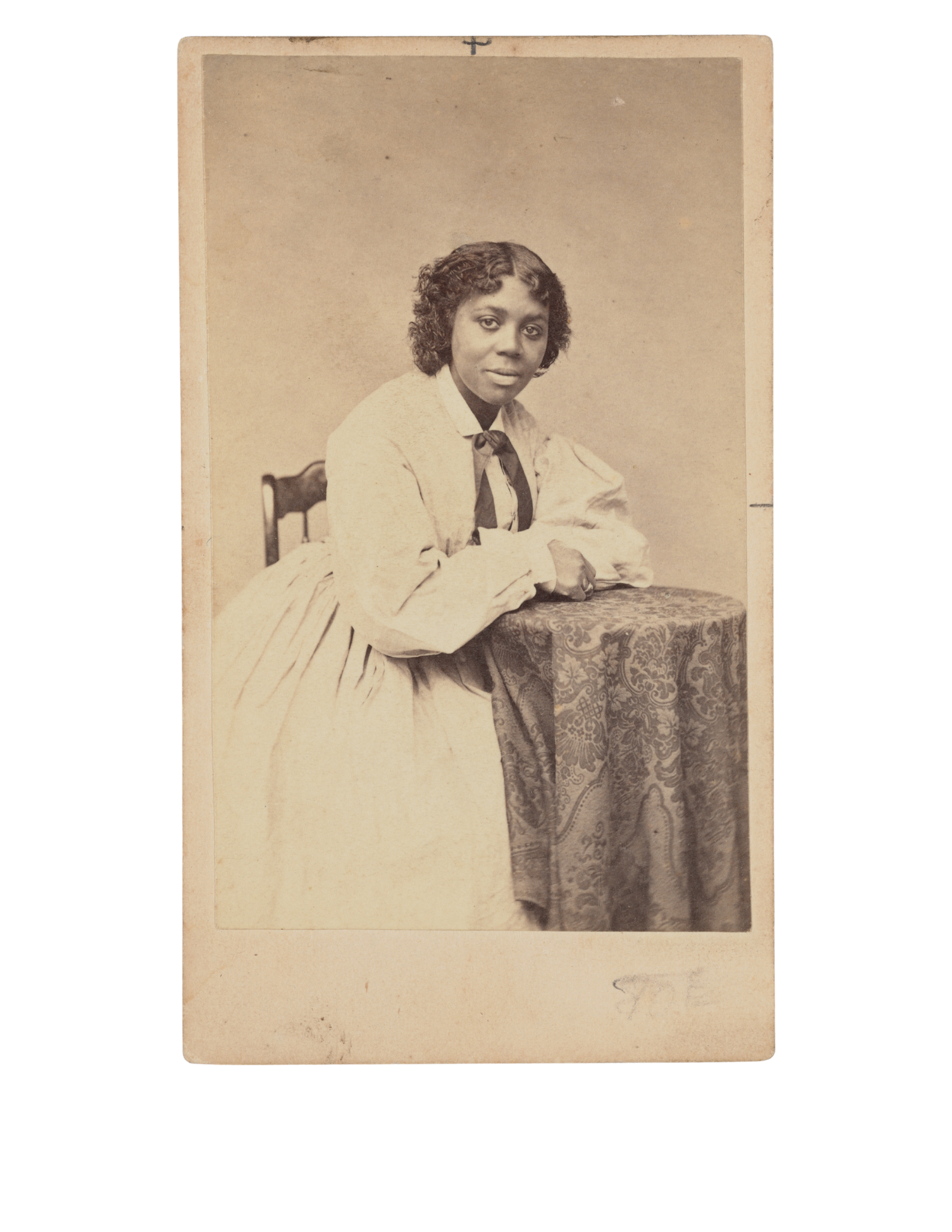
★ EDMONIA “WILDFIRE” LEWIS ★
July 4, 1844 – September 17, 1907

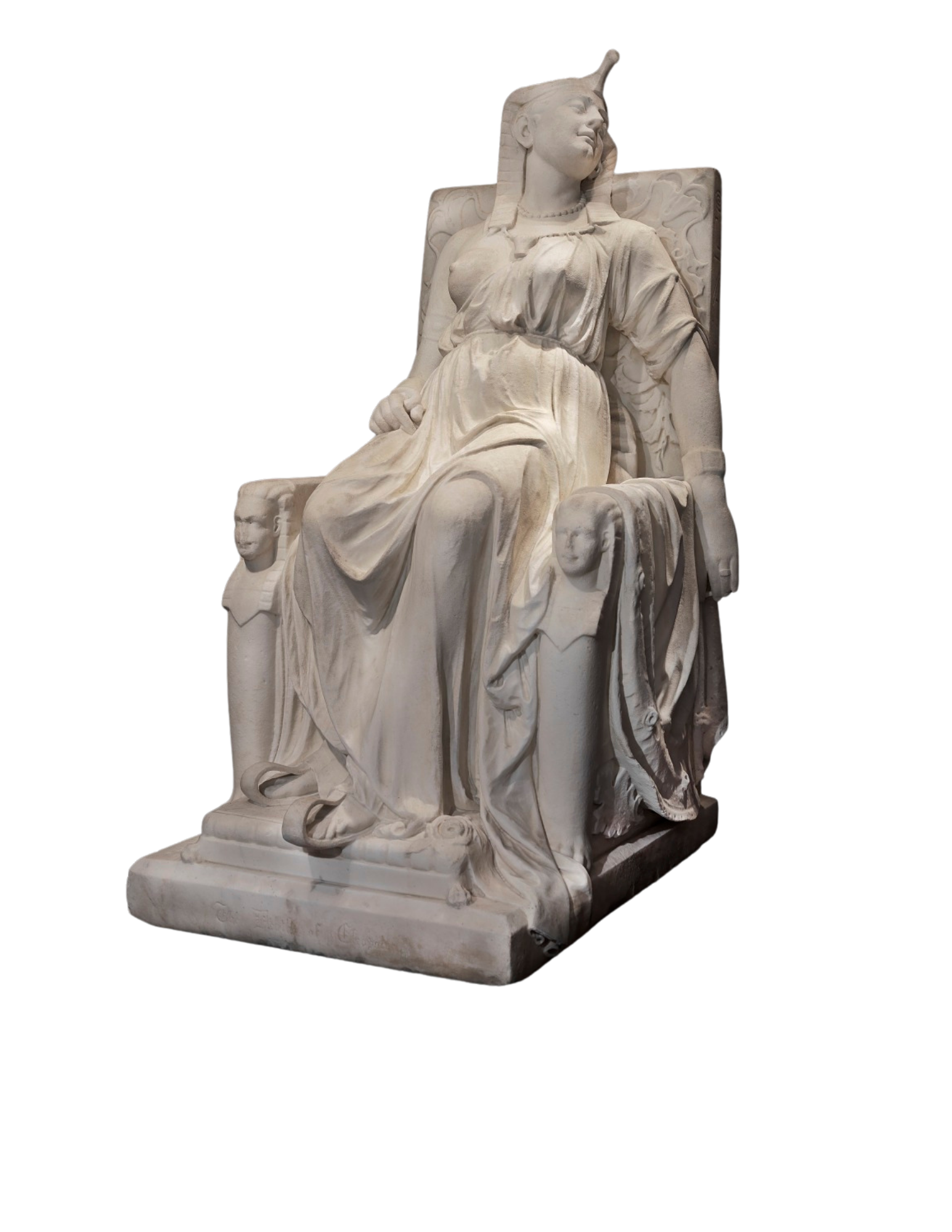
★ Black American + Chippewa, Ojibwe (Mississauga Nation) artist whose narrative marble sculptures garnered international fame during the latter half of the 1800s.
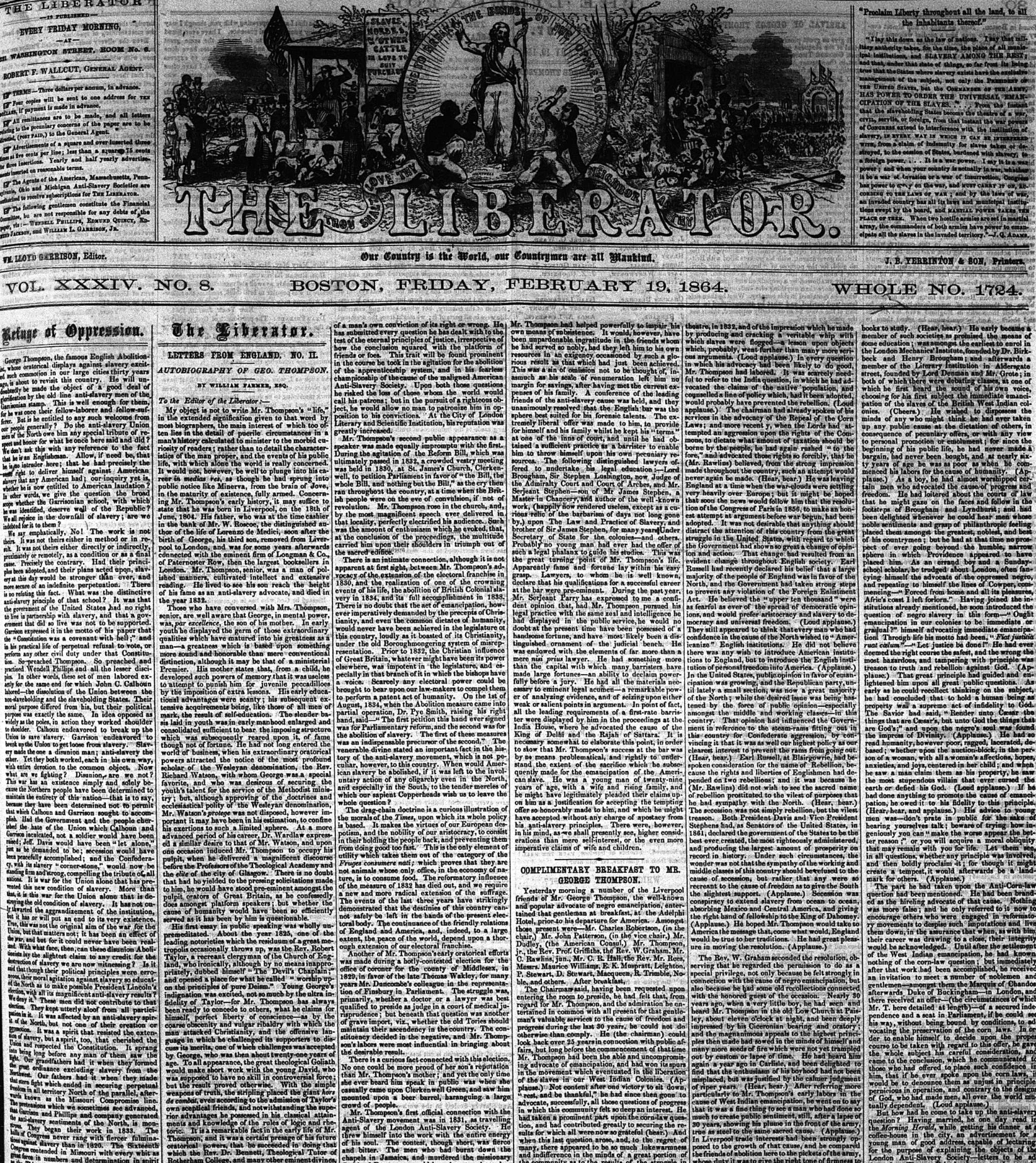
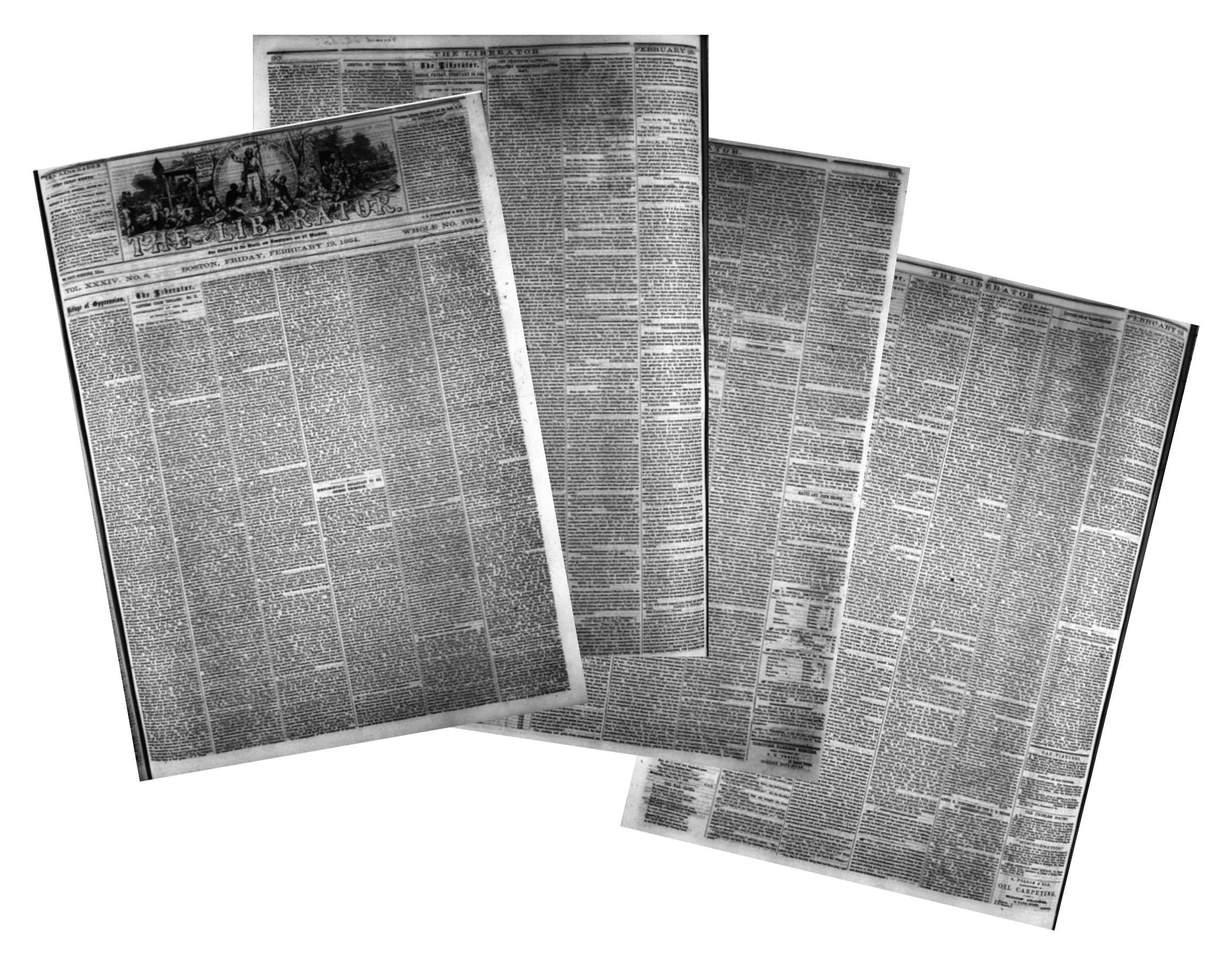
Edmonia Lewis was one of the most prominent sculptors of the 19th century. Being of Black and Indigenous descent, she discussed her identity and its influence on her sculpture practice in the following transcribed interview featured in the February 19, 1864, issue of The Liberator, an abolitionist newspaper published between 1831 and 1865 out of Boston, MA.
★ BACKGROUND IMAGE ★ The Liberator, Boston, Weekly Abolitionist Newspaper, February 19, 1864.
↓ READ THE TRANSCRIBED PORTION OF HER FEBRUARY 1864 INTERVIEW ↓
“…One of the most interesting individuals I met at the reception was Edmonia Lewis, a colored girl about twenty years of age, who is devoting herself to sculpture. Her frank, intelligent countenance and modest manners prepossessed me in her favor. I told her I judged by her complexion that there might be some of what was called white blood in her veins. She replied, ‘No; I have not a single drop of what is called white blood in my veins. My father was a full-blooded Negro, and my mother was a full-blooded Chippewa.’
‘…And have you lived with the Chippewas? “Yes. When my mother was dying, she wanted me to promise that I would live three years with her people, and I did. […] I did as my mother’s people did. […] I liked it a great deal better than I do your civilized life. There is nothing so beautiful as the free forest. To catch a fish when you are hungry, cut the boughs of a tree, make a fire to roast it, and eat it in the open air, is the greatest of all luxuries. I would not stay a week pent up in cities, if it were not for my passion for Art.’” (The Liberator, 1864).

★ EDMONIA LEWIS WAS INTERVIEWED FOR THE LIBERATOR, A BOSTON-BASED WEEKLY ABOLITIONIST NEWSPAPER ★
Friday, February 19, 1864
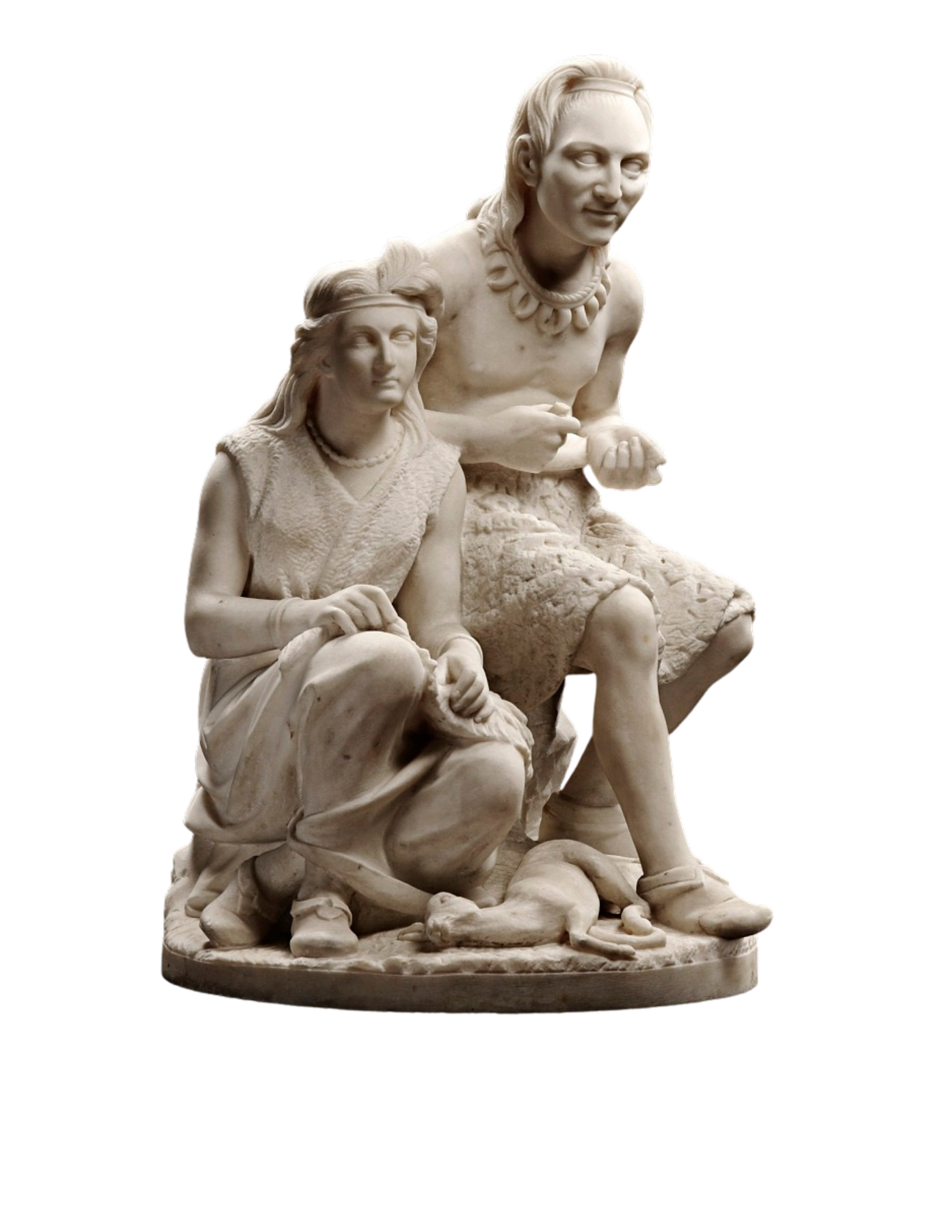
↓ These sculptures are preserved by Howard University and the Smithsonian American Art Museum, respectively. They are featured here to show the breadth of Edmonia Lewis’s marble craftsmanship.
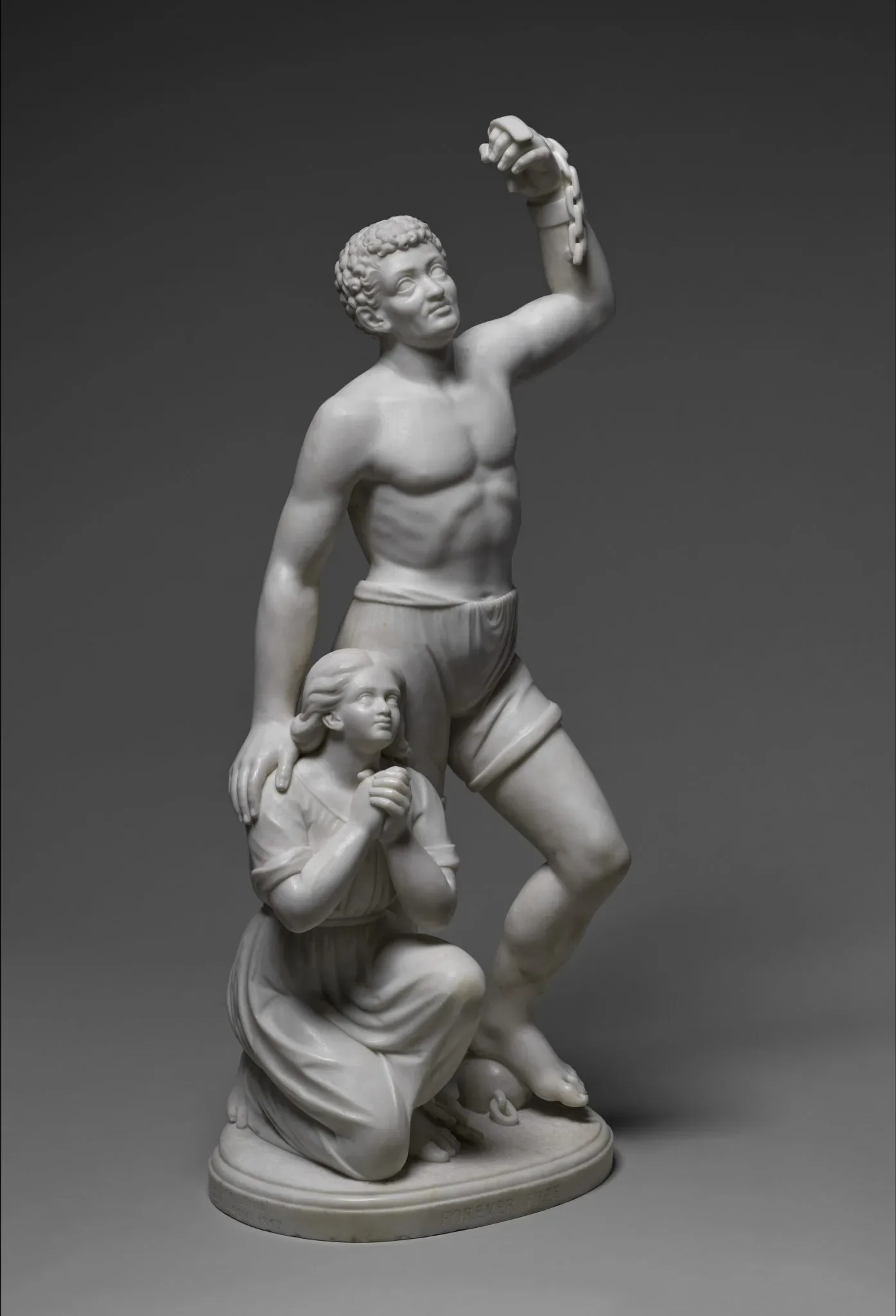
★ Edmonia Lewis, Forever Free (1867). Marble. Dimensions, H. 41 3/4 in. (106 cm), W. 22 1/2 in. (57.2 cm), D. 12 3/8 in. (31.4 cm). Howard University Fine Arts Collection, Washington, D.C. (67.9.S). Object ID, CARP.017. Photo courtesy of the Metropolitan Museum of Art, New York.
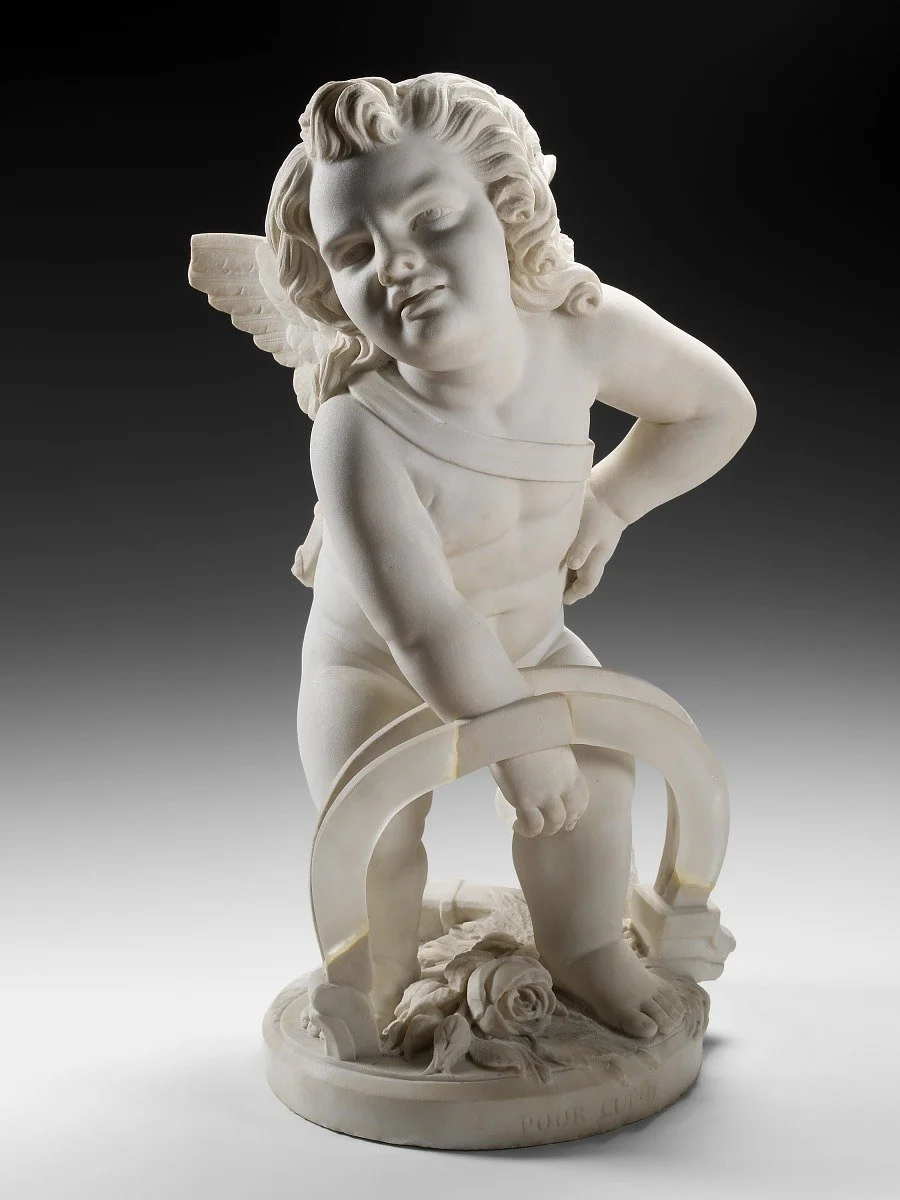
★ Edmonia Lewis, Poor Cupid, modeled ca. 1872, carved 1876, marble, 27 x 13 3/4 x 12 1/4 in. (68.6 x 34.9 x 31.1 cm.), Smithsonian American Art Museum, Gift of Alfred T. Morris, Sr., 1984.156
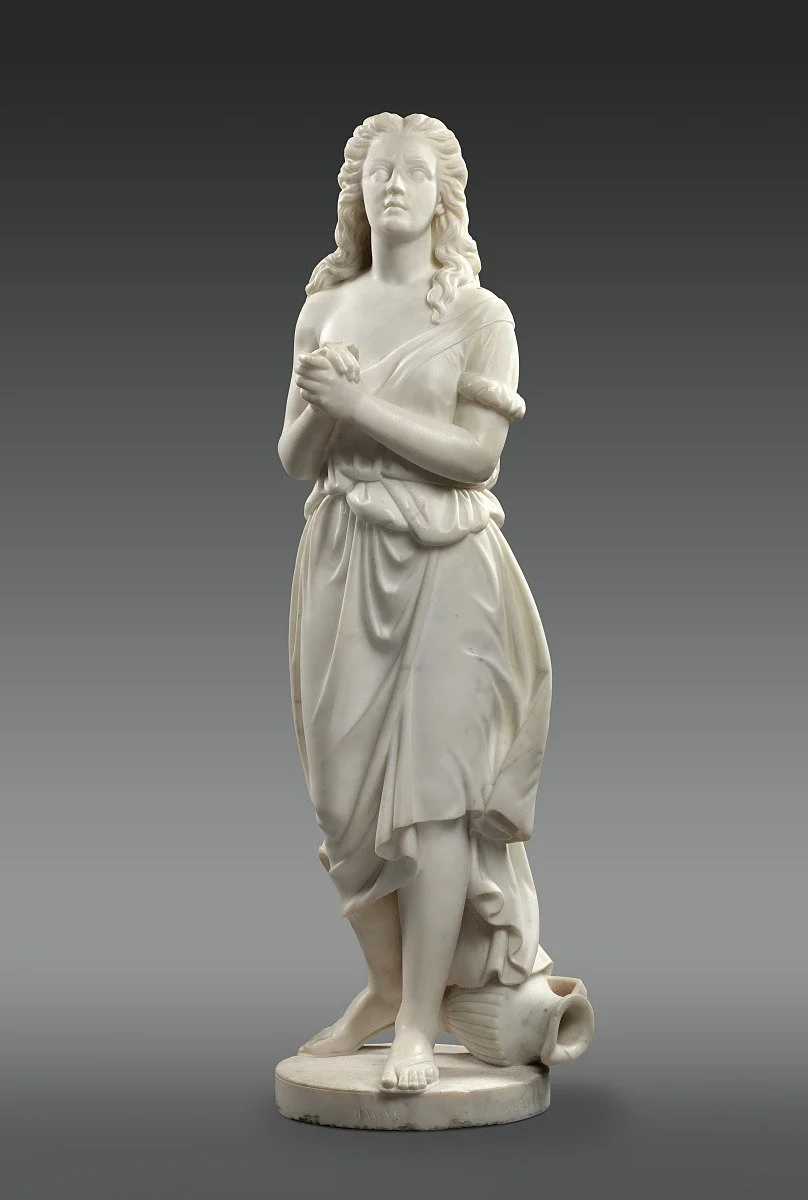
★ Edmonia Lewis, Hagar, 1875, carved marble, 52 5/8 x 15 1/4 x 17 1/8 in. (133.6 x 38.8 x 43.4 cm.), Smithsonian American Art Museum, Gift of Delta Sigma Theta Sorority, Inc., 1983.95.178
★ For more reading materials about Edmonia Lewis’s life story ↓ Visit the Schomburg Center’s Jean Blackwell Hutson General Research + Reference Division:
Edmonia Lewis: Said in Stone / Peabody Essex Museum, Salem, Massachusetts (2026) / Call No. Sc+ G 26-25.
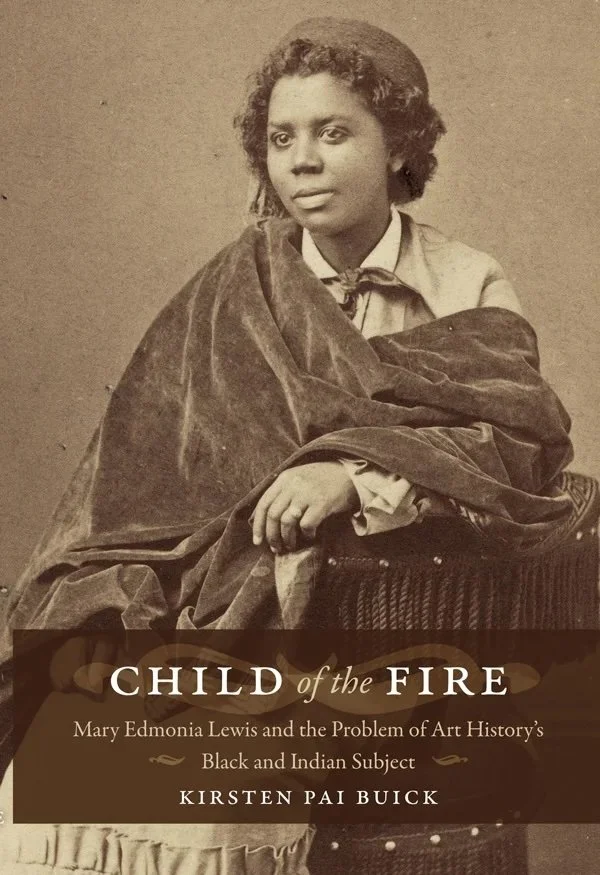
Child of the Fire: Mary Edmonia Lewis and the Problem of Art History's Black and Indian Subject / by Kirsten Pai Buick (2010) / Call No. Sc E 10-618.
I AM Edmonia Lewis and I AM “Wildfire” / by Synthia Saint James (2016) / Call No. Sc E 22-1540.
Stone Mirrors: The Sculpture and Silence of Edmonia Lewis / by Jeannine Atkins (2017) / Call No. Sc D 17-488.
Pieces of Freedom: The Emancipation Sculptures of Edmonia Lewis and Meta Warrick Fuller / by Lee Ann Timreck, Afterword by Alex Bostic (2023) / Call No. Sc D 24-514.
Race and Racism in Nineteenth-century Art: The Ascendency of Robert Duncanson, Edward Bannister, and Edmonia Lewis / by Naurice Frank Woods, Jr. (2021) / Call No. Sc E 22-539.
Seen. Edmonia Lewis / by Jasmine Walls, Illustrated by Bex Glendining (2020) / Call No. Sc C 22-65.
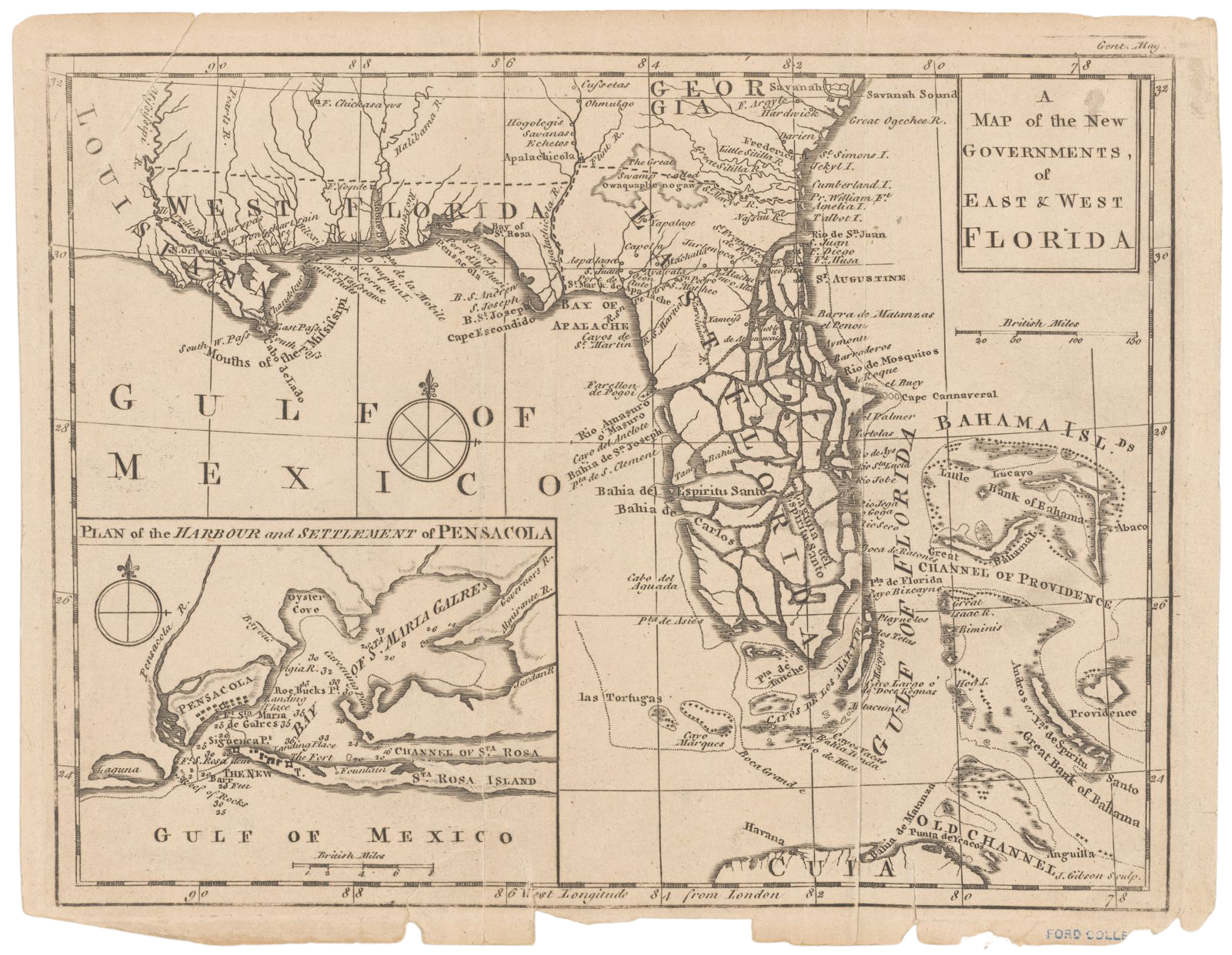
★ c. 1763, Map of the new Governments of East & West Florida. Lionel Pincus and Princess Firyal Map Division. The New York Public Library, Digital Collections. IMAGE ID [57205677].
★ BLACK SEMINOLES ★
Under Spanish rule in Florida prior to the Transcontinental Treaty of 1819, many enslaved Africans in southern states and territories escaped to the swampy marshes of Spanish Florida, where slavery had been abolished since 1693.
This migration created a subculture of newly free, formerly enslaved Africans (or Maroons) and the Seminole Nation already inhabiting the region. They banded together to fight European colonization of Florida during the Seminole Wars; Black Seminoles (or Seminole Maroons) were noted for their bravery and military acumen.
The 1840s Trail of Tears forced thousands of Florida Seminoles, including Black Seminoles, to what was then called “Indian Territory,” or present-day Oklahoma. After being forcibly relocated, they were subjugated by the Creek Nation. Many Black Seminoles later migrated to parts of Texas and Mexico, in Coahuila, where they were known as “Mascogos.”
Explore the following reading lists for more information about their history.
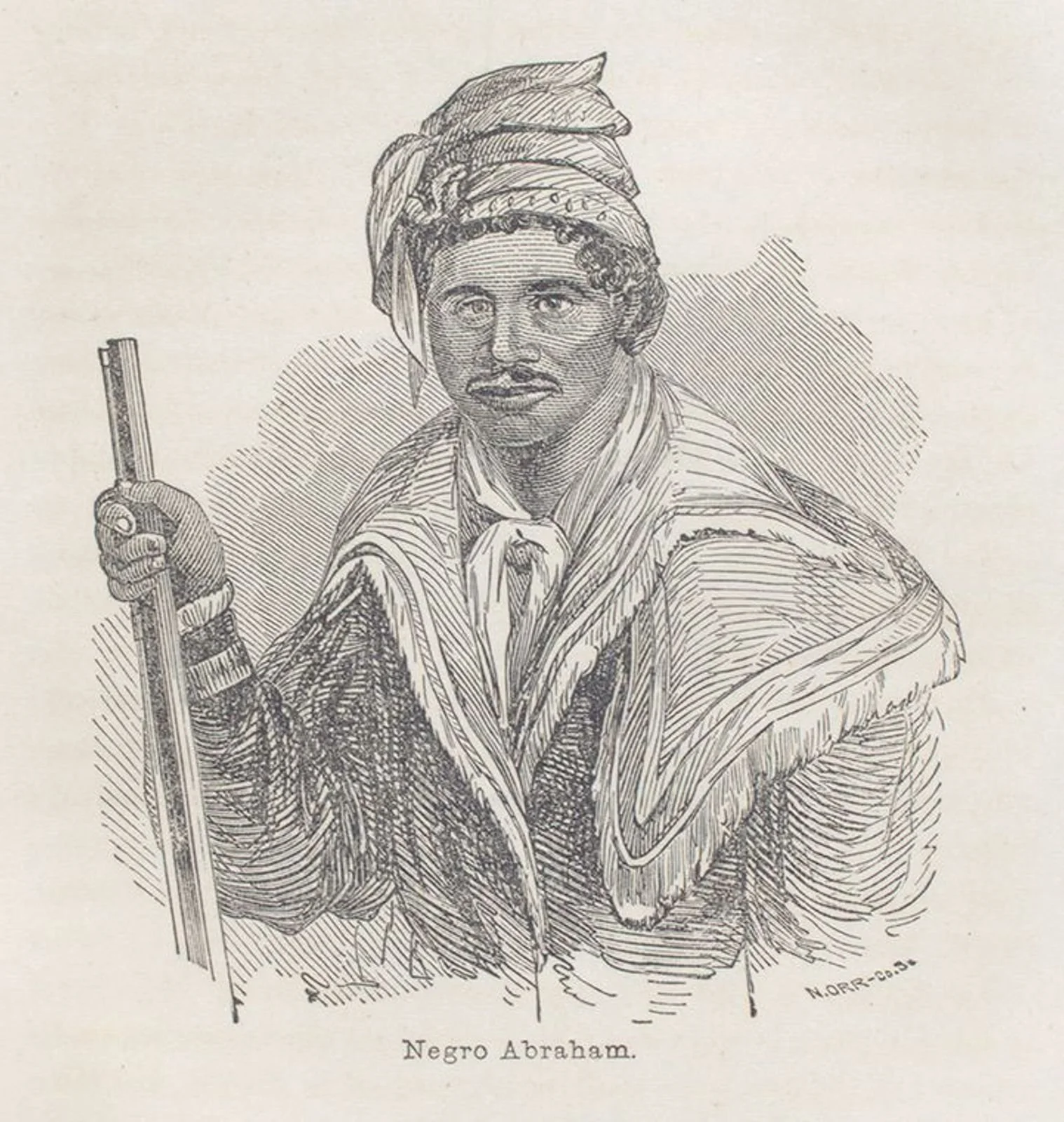
★ Pictured here, c. 1863, Engraved illustration of a Seminole Negro man named Negro Abraham. From “The Florida Exiles and the War for Slavery: The Crimes Committed by Our Government Against the Maroons, Who Fled from South Carolina and Other Slave States, Seeking Protection Under Spanish Laws.” Manuscripts, Archives, and Rare Books Division, Schomburg Center for Research in Black Culture. New York Public Library Digital Collections. IMAGE ID [490272].

★ c. 1875, Stereograph of Black Seminoles (Texas). The Miriam and Ira D. Wallach Division of Art, Prints and Photographs: Photography Collection, The New York Public Library. The New York Public Library Digital Collections. Image ID [G92F037_013F]
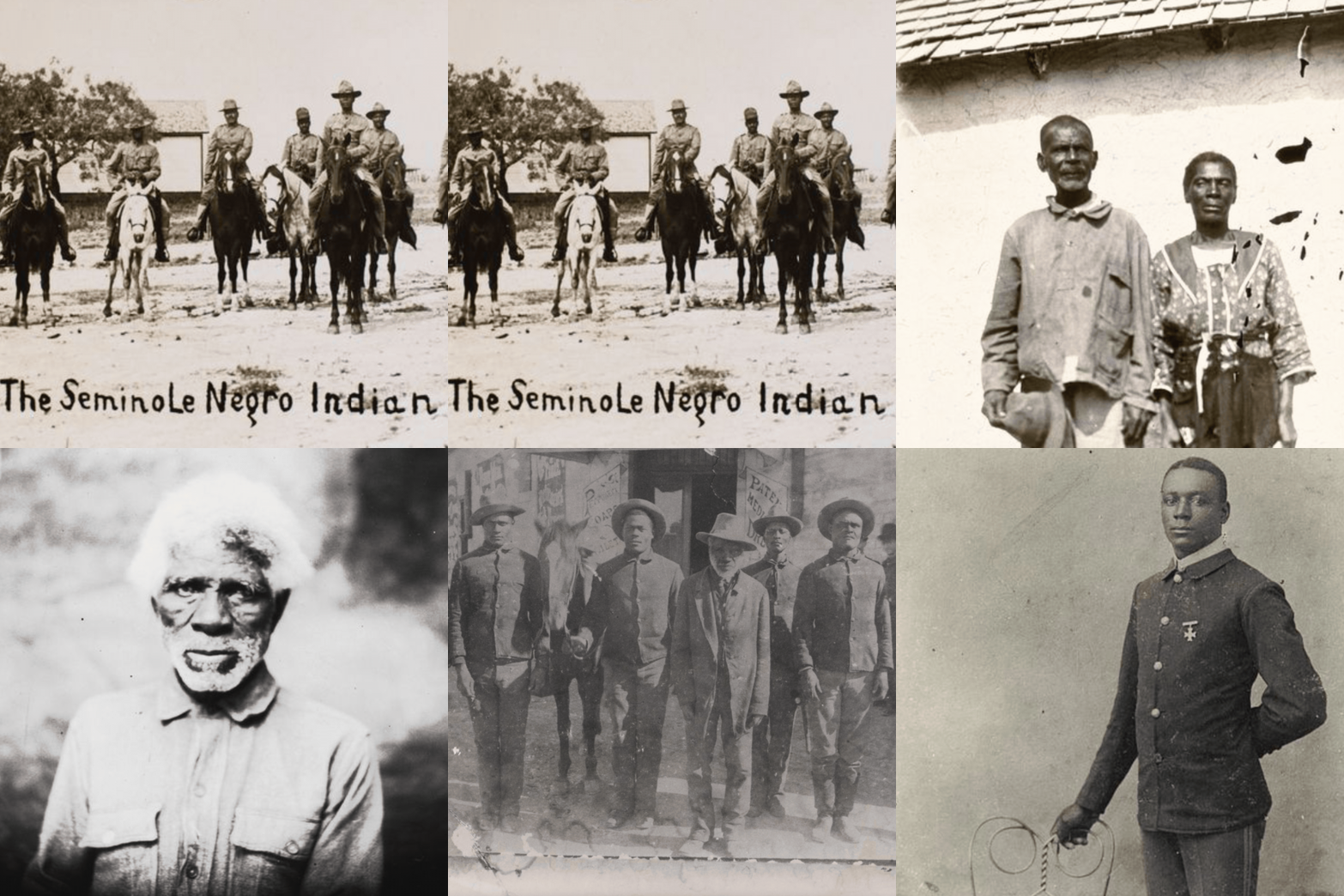
→ CLICK HERE TO VIEW DIGITIZED PHOTOGRAPHS OF BLACK SEMINOLES, PRESERVED BY THE SCHOMBURG CENTER’S PHOTOGRAPHS + PRINTS DIVISION ★
★ Further reading on Black Seminoles ↓
The Black Seminoles: History of a Freedom-Seeking People / by Kenneth W. Porter, revised and edited by Alcione M. Amos and Thomas P. Senter. (1996) / Call No. Sc D 96-917.
Florida's Negro War: Black Seminoles and the Second Seminole War 1835-1842 / by Anthony E. Dixon. (2023) / Call No. Sc E 26-365.
The Texas Seminoles and Their Language / by Ian F. Hancock (1980) / Call No. Sc F 26-71.
A Man Called Horse: John Horse and the Black Seminole Underground Railroad / by Glennette Tilley Turner. (2021) / Call No. Sc D 22-176.
Dreaming with the Ancestors: Black Seminole Women in Texas and Mexico / by Shirley Boteler Mock. (2010) / Call No. Sc E 11-196.
The Black Seminole Legacy and North American Politics, 1693-1845 / by Bruce Edward Twyman. (1999) / Call No. Sc E 00-1173.
Our Land Before We Die: The Proud Story of the Seminole Negro / by Jeff Guinn. (2002) / Call No. Sc E 02-1618.
Freedom on the Border: the Seminole Maroons in Florida, the Indian territory, Coahuila, and Texas / by Kevin Mulroy. (1993) / Call No. Sc E 95-147.
The Seminole Freedmen: A History / by Kevin Mulroy. (2007) / Call No. Sc E 08-436.
A Brief History of the Seminole-Negro Indian Scouts / by Thomas A. Britten. (1999) / Call No. Sc E 99-1177.
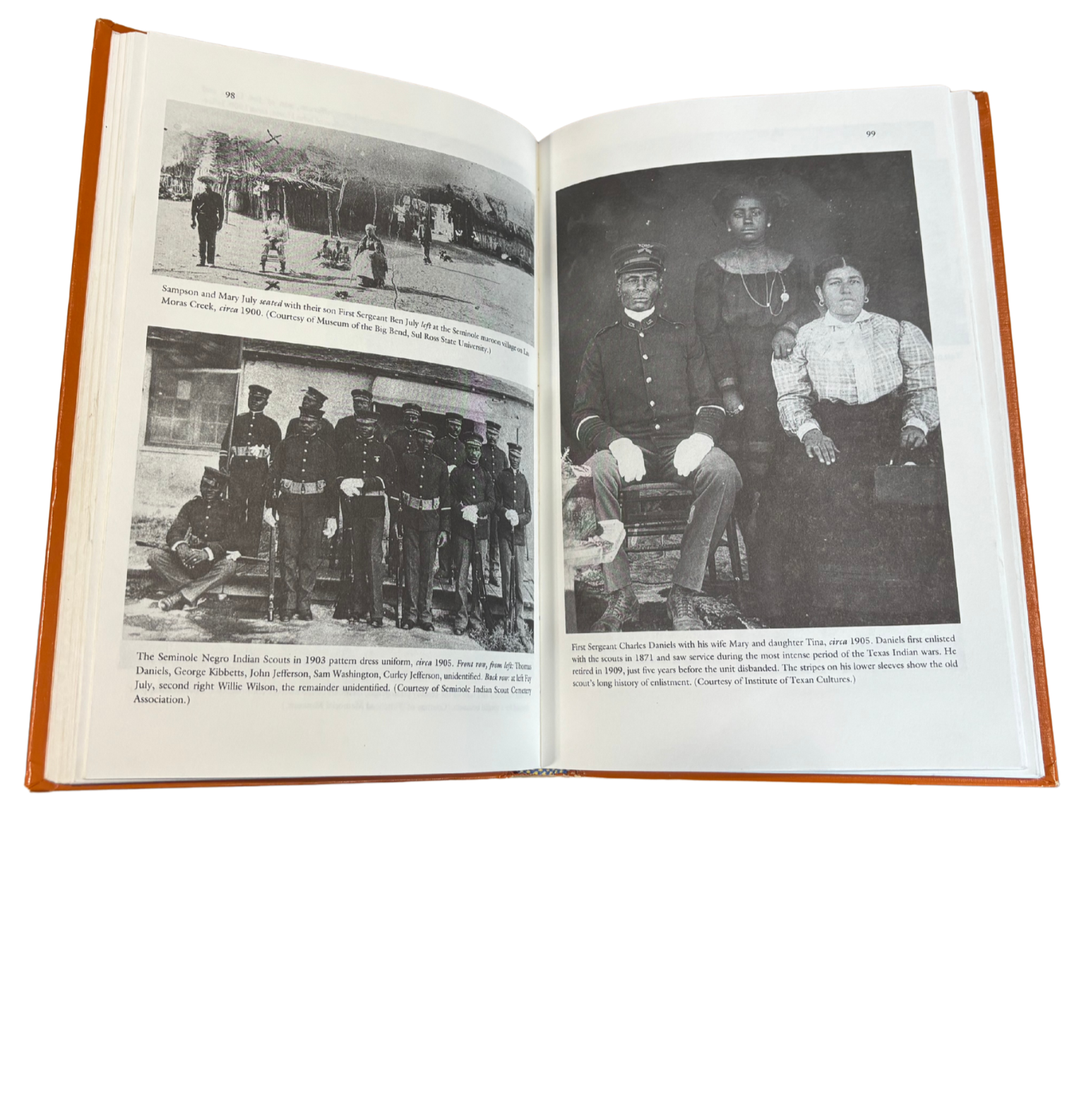
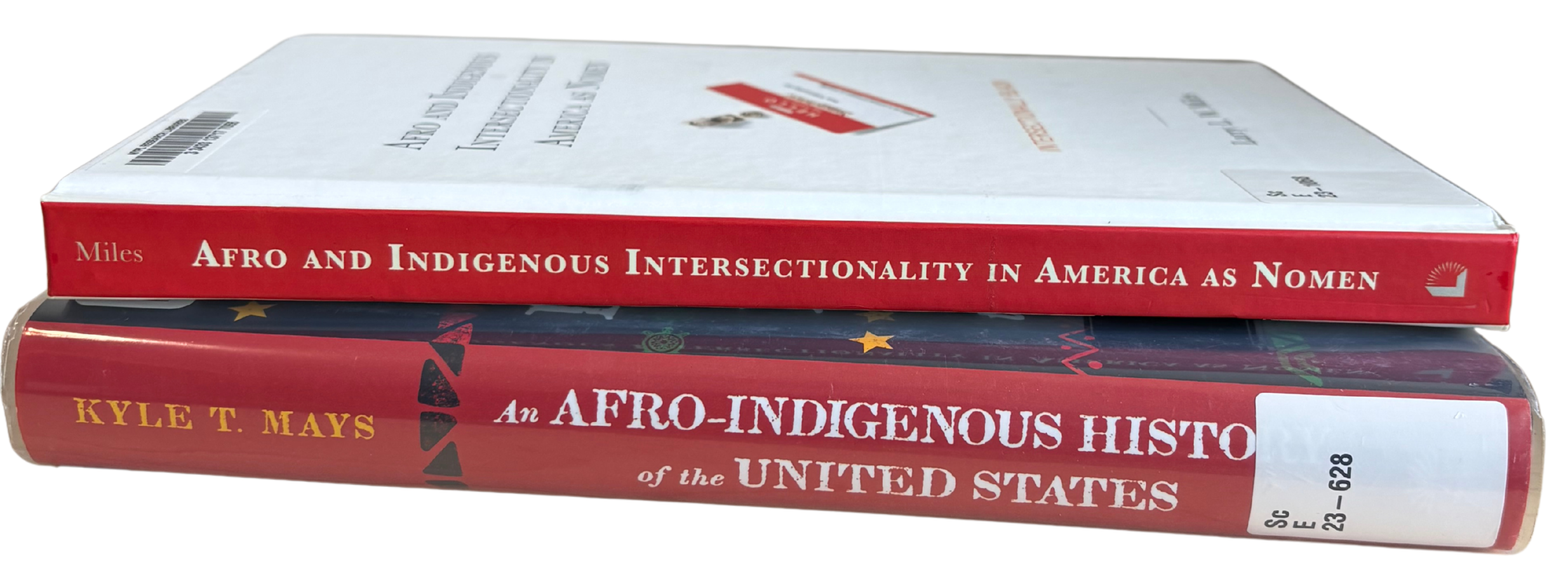
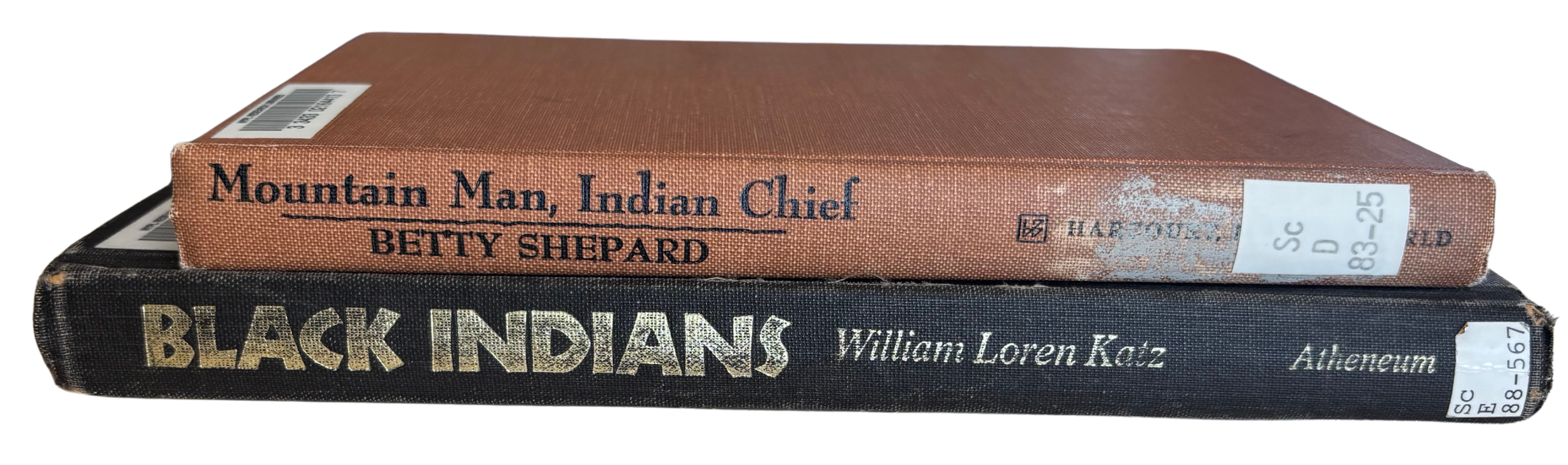
★ Afro + Indigenous Reading List ★
★ Jean Blackwell Hutson Research + Reference Division
Both Sides of the Water: Essays on African-Native American Interactions / by Lonnie Harrington (2006) / Call No. Sc E 09-167.
African Americans and Native Americans in the Creek and Cherokee Nations, 1830s to 1920s: Collision and Collusion / Katja May (1996) / Call No. Sc D 96-435.
Slavery and the Evolution of Cherokee Society, 1540 - 1866 / by Theda Perdue (1979) / Call No. Sc D 79-300.
Trails to Grandma's House: The Darkest Tears on the Trail of Tears: Blacks Involved in the Removal of the Five Civilized Tribes, Cherokee, Choctaw, Creek, Chickasaw and Seminoles / by Gloria L. Smith (1995) / Call No. Sc F 10-287.
Africans and Native Americans: The Language of Race and the Evolution of Red-Black Peoples / by Jack D. Forbes (1993) / Call No. Sc D 97-921.
Africans and Creeks: From the Colonial Period to the Civil War / by Daniel F. Littlefield (1979) / Call No. Sc D 80-54.
Black Indian Genealogy Research / by Angela Y. Walton-Raji (1993) / Call No. Sc D 97-973.
When Brer Rabbit meets Coyote: African-Native American literature / by Jonathan Bradford Brennan (1997) / Call No. Sc D 99-636.
Understanding the Connection Between Black and Aboriginal Peoples: The Links Between African-American, Black, Native American, and Indigenous Cultures / by Raging BlakkIndian Dub (2002) / Call No. Sc D 03-1717.
Making of an Afro Indian, 1835 to 2002: and How American Spirit Was Killed / by Wendell Sexton (1995) / Call No. Sc D 03-2840.
Crossing Waters, Crossing Worlds: The African Diaspora in Indian Country / edited by Tiya Miles and Sharon P. Holland (2006) / Call No. Sc E 08-298.
★ MANUSCRIPTS, ARCHVIES + RARE BOOKS DIVISION
William Loren Katz Manuscript + Research Collection / Call No. Sc MG 139. / FROM THE FINDING AID: The William Loren Katz Manuscript and Research collection contains Katz's research files, drafts, and correspondence related to the research, development and publication of: "Eyewitness: the Negro in American History," "The History of the Black West," "A History of Black Americans," and "Black Indians: a Hidden Heritage." For "The Black West" there are a large number of photographic negative prints.
Kenneth W. Porter Papers / Call No. Sc MG 222. / FROM THE FINDING AID: Kenneth W. Porter conducted research on African-American frontiersmen and cowboys, Black Seminoles, and American folklore and folk history. This collection consists primarily of his manuscripts and research materials pertaining to African-American and Native American studies.
★ MOVING IMAGES + RECORDED SOUND DIVISION
For the People: Black Africans and Native Americans / 28min. videocassette, South Carolinal ETV. / Call No. Sc Visual VRA-83 Service Copy. / SUMMARY: Jack Forbes, author of Black Africans and Native Americans: Color, Race and Caste in the Evolution of Red-Black Peoples, talks with host Listervelt Middleton about the first contact between Africans and Native Americans and the enslavement of Native Americans. *This program forms part of the Communications Excellence to Black Audiences (CEBA) Award collection, a competition sponsored by the World Institute of Black Communications, inc.
*CLICK ANY IMAGE BELOW ⇩ to continue exploring related photographs + resources.